
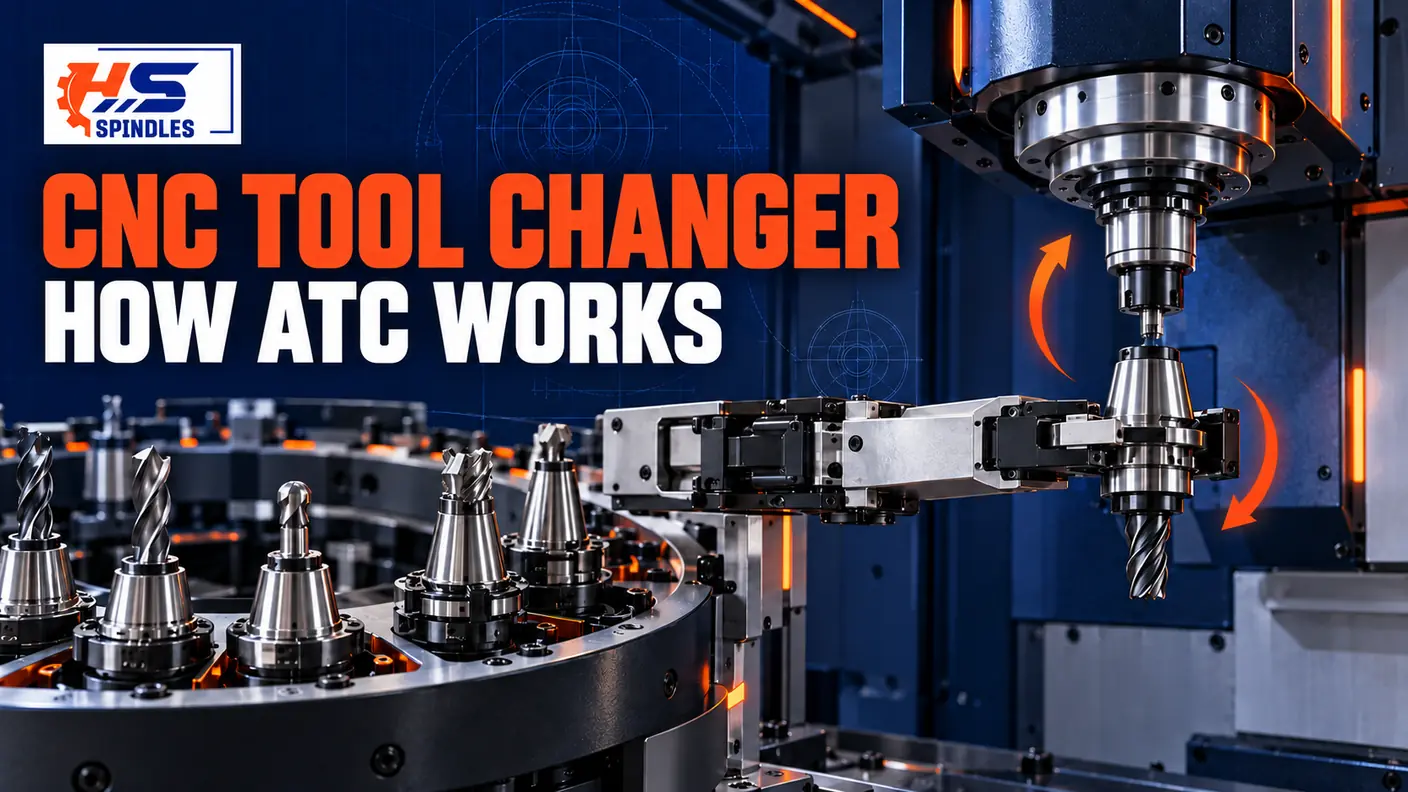
A CNC tool changer — also called an ATC (Automatic Tool Changer) — is a system that automatically stores multiple cutting tools and swaps them in and out of the spindle during a CNC machining program, without stopping the machine or requiring operator intervention. Tool changers are what allow a single CNC machine to perform drilling, routing, profiling, and sawing operations in a single setup.
How Does an ATC Work?
The automatic tool change cycle typically follows these steps:
- Program calls tool change: The CNC controller executes a tool change command (M06 T2, for example)
- Spindle returns to tool change position: The machine moves to a safe, fixed position — usually above the tool carousel
- Spindle slows and orients: The spindle decelerates and rotates to a specific angular position (orientation) so the tool slot aligns with the ATC gripper
- Drawbar releases: The drawbar mechanism inside the spindle retracts, releasing the tool holder
- Tool is removed: The carousel or robotic arm removes the tool holder from the spindle
- New tool is loaded: The next tool holder is picked from its storage position and inserted into the spindle
- Drawbar engages: The drawbar pulls the tool holder up into the spindle taper and clamps it firmly
- Confirmation: The machine verifies tool presence and correct clamping before the program continues On a well-maintained spindle with HSK 63F toolholders, this full cycle takes approximately 3–8 seconds.
The reliability of this process depends on using accurately manufactured CNC toolholders that match the spindle interface and automatic tool-change system.
Types of CNC Tool Changers
Carousel ATC (Hat-Type)
The most common type on CNC routers. A rotating carousel (hat) mounted above or beside the work area stores 8–24 tools. The spindle moves to the carousel position for every tool change.
Pros: Simple, reliable, cost-effective
Best for: Woodworking, cabinet, and panel routing machines
Rack-Style ATC (Linear Magazine)
Tools are stored in a linear rack at one end of the machine. The spindle travels to the rack for tool changes. Can store more tools than a carousel.
Best for: Machines running many different operations — furniture, composite, sign-making
Robotic ATC (Arm-Type)
A robotic arm mechanism removes the old tool and inserts the new tool simultaneously. Much faster cycle time but mechanically more complex.
Best for: High-production machining centres where tool change time is a significant portion of cycle time
HSK 63F vs ISO30 Tool Changers
The two dominant interfaces for CNC router tool changers are HSK 63F and ISO30:
| Feature | HSK 63F ATC | ISO30 ATC |
| Interface type | Hollow taper + face contact | 30-taper, taper only |
| Change speed | Faster — lighter, more precise | Slightly slower |
| Rigidity | Higher | Adequate for wood routing |
| Runout repeatability | <0.003mm | 0.003–0.008mm |
| Common brands | Biesse, SCM, Homag, Holz-Her | AXYZ, MultiCam, Thermwood |
HS Spindles supplies both HSK 63F toolholders and ISO30 toolholders for CNC routers equipped with automatic tool changers.
HSK 63F tool changers are standard on European-specification CNC routers. ISO30 is more common on North American-brand machines.
When to Replace Your Tool Changer Components
ATC systems have wear components that require periodic replacement. Signs it is time for service:
- Inconsistent tool clamping: Tools feel loose or produce inconsistent Z-height readings
- Tool change failures: Machine faults during the ATC cycle
- Increased tool change time: Pneumatic system hesitation or mechanical wear
- Tool orientation errors: Spindle not stopping at the correct position for the tool arm
The gripper dogs—also called tool forks—are among the most frequently replaced ATC components. Browse our CNC tool forks for HSK 63F and ISO30 automatic tool-change systems.
Frequently Asked Questions
How many tools can a CNC tool changer hold?
Most CNC router ATCs hold 8–24 tools. Machining centre ATCs hold 20–100 or more. The capacity is set by the carousel or magazine size at purchase.
Does tool changer type affect machining accuracy?
Yes. HSK 63F changers have superior runout repeatability vs ISO30 — important for precision work in aluminium, composites, or fine woodworking. For standard wood routing, the difference is minimal in practice.
How often should ATC components be serviced?
Drawbar force should be verified every 500 hours. Tool forks (grippers) should be inspected every 500 hours and replaced when worn. Pneumatic lines and seals should be checked annually.

