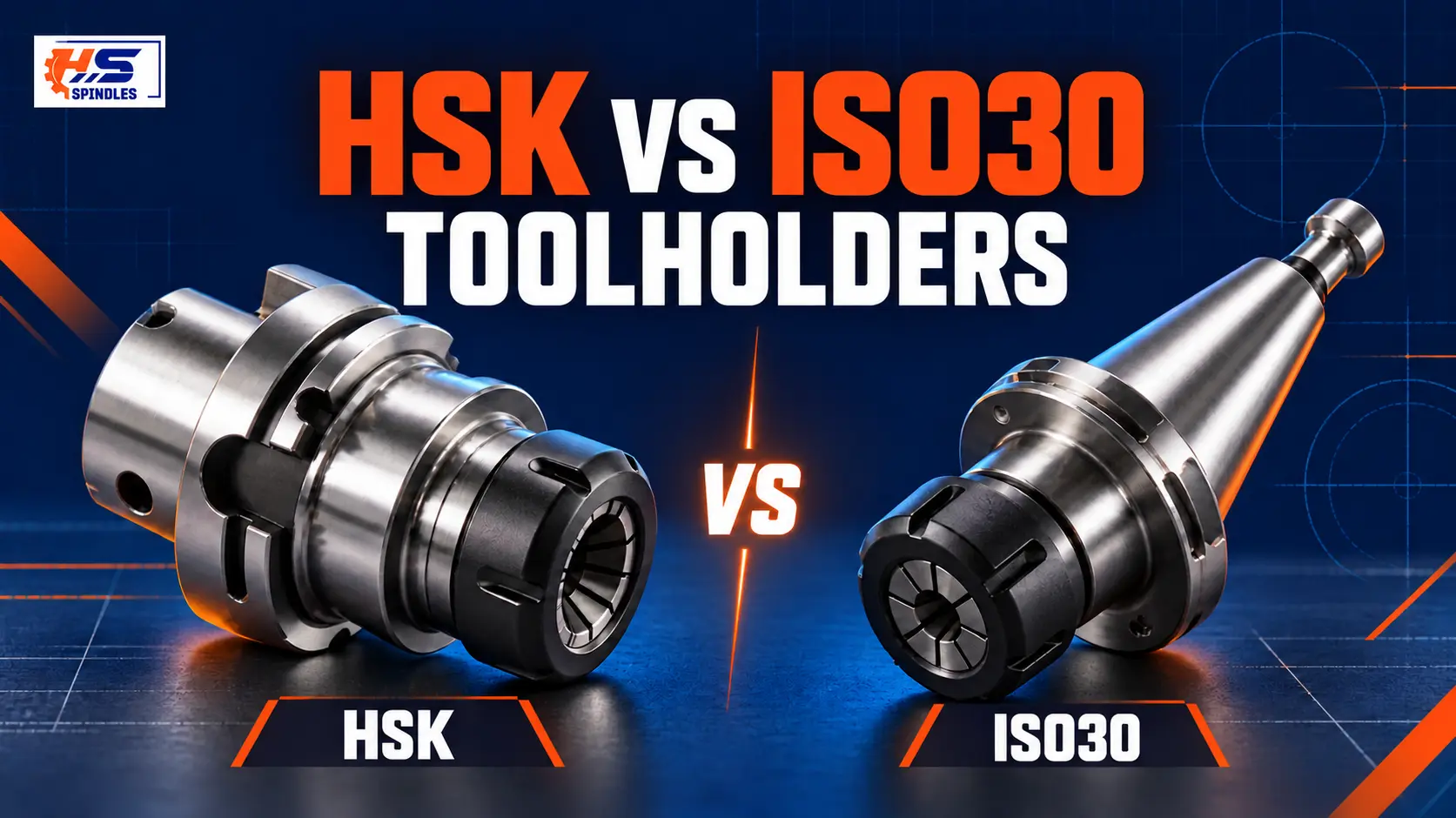
HSK toolholders and ISO30 toolholders are two of the most common interfaces used on CNC routers and woodworking machines. HSK 63F provides greater rigidity, better high-speed performance and more repeatable tool changes, while ISO30 is widely used on North American CNC routers and generally costs less. However, these interfaces are not interchangeable—the spindle installed on your machine determines which toolholder you need.
HSK Toolholders vs ISO30: The Core Design Difference
ISO30 Toolholders
ISO30 is a tapered tool holder interface based on a 30-taper (7:24 ratio) design. The tool holder contacts the spindle on the taper only — there is no face contact with the spindle nose. This is the same family as CAT40/BT40 used in machining centres, but in a smaller 30-taper size developed for high-speed routing.
ISO30 has been the dominant interface on North American CNC routers since the 1990s. Machines from AXYZ, MultiCam, Thermwood, ShopBot (industrial), and many others use ISO30 spindles.
ISO30 characteristics:
- Simple taper-only clamping
- Tool change via collet drawbar
- Common on North American CNC routers
- Lower cost per holder than HSK
- Suitable for speeds up to ~24,000 RPM
How HSK Toolholders Work
HSK (Hohlschaftkegel — hollow taper shank) uses a simultaneous taper and face contact design. The tool shank contacts both the spindle taper and the spindle face at the same time, creating a much more rigid and repeatable connection than taper-only clamping.
HSK 63F toolholders use the F-flange variant of HSK 63, designed specifically for high-speed CNC routing and woodworking. It has become the dominant interface on European CNC routers and is increasingly common worldwide.
HSK 63F characteristics:
- Dual contact (taper + face) — significantly higher rigidity
- Faster, more reliable ATC at high speeds
- Better runout repeatability (typically <0.003mm at the spindle)
- Required for spindles above 18,000 RPM in demanding applications
- Common on Biesse, SCM, Homag, Holz-Her, IMA machines
HSK Toolholders vs ISO30 Comparison Table
| Feature | HSK 63F | ISO30 |
| Contact type | Taper + face (dual) | Taper only |
| Rigidity | Higher — better for harder materials | Adequate for most wood routing |
| ATC reliability at speed | Excellent — designed for high-speed ATC | Good — at lower cycle rates |
| Max recommended speed | 30,000+ RPM | ~24,000 RPM |
| Runout repeatability | <0.003mm typical | 0.003–0.008mm typical |
| Tool holder cost | Higher | Lower |
| Common machine brands | Biesse, SCM, Homag, Holz-Her | AXYZ, MultiCam, Thermwood, Rover (older) |
| Aggregate compatibility | Most Hiteco, Leuco aggregates | Most North American aggregates |
Toolholder compatibility also affects the spindle’s automatic tool-change components. If your machine is dropping tools, failing to release them or producing inconsistent seating, inspect the matching tool changer grippers for wear.
Which Toolholder Does My Machine Need?
You cannot choose between HSK 63F and ISO30 — your spindle determines which interface you use. The toolholder must match the spindle interface exactly. If you are also comparing spindle speed, cooling method and interface options, read our precision spindle selection guide before choosing a replacement spindle.
To identify your interface:
- Check the spindle model number on the machine label
- Look at your existing toolholders — they will be marked “HSK 63F” or “ISO30” / “BT30”
- Contact the machine manufacturer with the serial number
HSK 63F Toolholder Sizes — ER16 to ER40
HSK 63F toolholders are available with different ER collet sizes and in short and long configurations:
| Toolholder | ER Size | Tool Diameter Range | Best Application |
| HSK 63F ER16 | ER16 | 1–10mm | Engraving, small routing bits |
| HSK 63F ER20 | ER20 | 1–13mm | General routing, smaller bits |
| HSK 63F ER25 | ER25 | 2–16mm | General routing, mid-size bits |
| HSK 63F ER32 | ER32 | 3–20mm | Large routing bits, compression bits |
| HSK 63F ER40 | ER40 | 3–26mm | Large diameter bits, heavy routing |
Short style holders position the tool closer to the spindle for maximum rigidity. Long style holders provide more Z-axis reach for deep operations or nested-base machining.
Where to Buy HSK 63F and ISO30 Toolholders
HS Spindles stocks precision-ground CNC toolholders in HSK 63F, HSK 63E, HSK 32E, HSK 25E, and ISO30 interfaces. All holders are precision-ground to P4 grade or better. Same-day shipping from Yorba Linda, CA.
Shop HSK 63F Toolholders → Shop ISO30 Toolholders → Browse all toolholders →
Frequently Asked Questions
What is the difference between HSK 63F and HSK 63E?
Both use the same HSK 63 shank diameter. The “F” variant has a flange design optimised for high-speed routing with automatic tool change — it is not symmetrical and has orientation features. The “E” variant is symmetrical and used in precision machining centres. Use HSK 63F for CNC routing machines, HSK 63E for machining centres.
Can I use HSK 63F toolholders on an ISO30 spindle?
No. The two interfaces are physically incompatible. HSK 63F uses a hollow taper shank; ISO30 uses a solid 30-taper. They require different spindle bore geometries and clamping mechanisms.
What ER collet size do I need?
The ER size must be equal to or larger than the shank diameter of your cutting tool. Use the largest ER size that fits — it provides more collet engagement and better clamping. A 12mm shank tool fits in ER16, ER20, ER25, ER32, and ER40 — choose ER20 or ER25 as a minimum for rigidity.
How do I know if my toolholder is worn out?
Signs of a worn toolholder: visible fretting on the taper surface, measured TIR (total indicator runout) above 0.01mm at the collet, inconsistent clamping force, discolouration from heat. Replace worn holders — a damaged holder will damage your spindle taper.

