
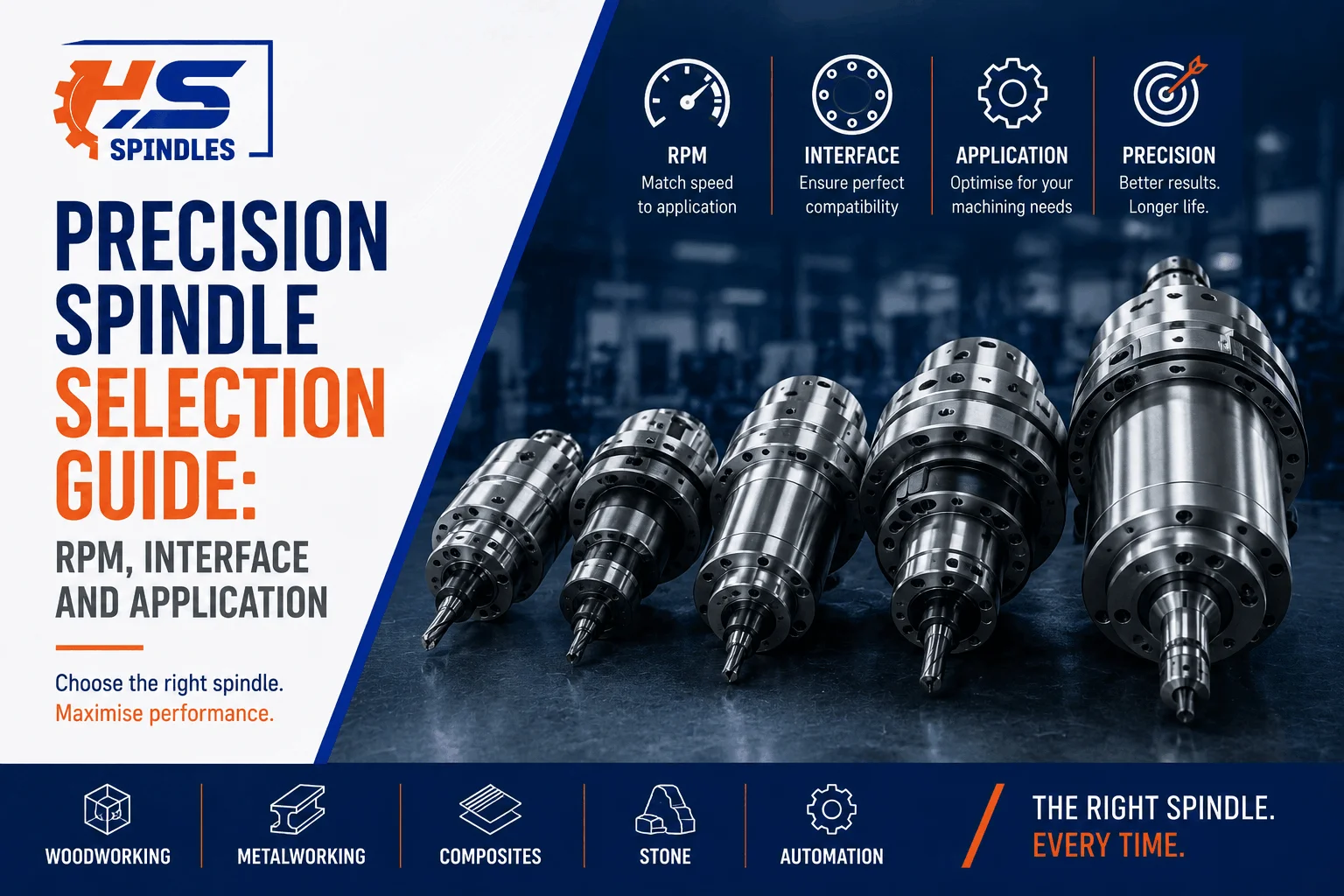
Precision Spindle Selection Guide: RPM, Interface and Application
Choosing the right precision spindle can have a major impact on machining accuracy, production speed, tool life, and overall machine performance. Whether you are upgrading an existing CNC machine or specifying equipment for a new project, selecting the correct spindle is one of the most important decisions you will make.
Many manufacturers focus only on horsepower or maximum speed, but spindle selection involves much more than that. Factors such as RPM requirements, toolholder interface, cooling method, application type, and machine compatibility all play a role in achieving the best results.
This guide explains the key considerations when selecting a precision spindle and helps manufacturing professionals make informed decisions based on their production needs.
What Is a Precision Spindle?
A precision spindle is the rotating component of a CNC machine responsible for holding and driving cutting tools. It must operate with extremely tight tolerances while maintaining accuracy at high speeds and under heavy loads.
Unlike standard industrial spindles, precision spindles are engineered to minimize runout, vibration, and thermal growth. These characteristics are critical for maintaining part quality, improving surface finish, and extending tool life.
Industries that commonly rely on precision spindle technology include:
- Aerospace
- Automotive manufacturing
- Cabinet and woodworking production
- Plastics machining
- Metal fabrication
- Composite manufacturing
- Medical device production
The right spindle can significantly improve productivity while reducing maintenance costs and downtime.
Understanding RPM Requirements
One of the first considerations when selecting a precision spindle is operating speed.
Different applications require different RPM ranges. Choosing a spindle with inappropriate speed capabilities can negatively affect machining performance and tool life.
Low RPM Applications
Heavy-duty cutting operations generally require lower spindle speeds and higher torque.
Examples include:
- Steel machining
- Titanium machining
- Large diameter tooling
- Roughing operations
- Heavy material removal
Typical spindle speed range:
6,000 to 12,000 RPM
In these applications, torque is often more important than maximum speed.
Medium RPM Applications
Many general-purpose machining operations fall into this category.
Examples include:
- Aluminium machining
- Plastic machining
- General CNC routing
- Mixed production environments
Typical spindle speed range:
12,000 to 18,000 RPM
This range provides a balance between speed and cutting power.
High RPM Applications
High-speed machining requires excellent spindle balance and precision.
Examples include:
- Finishing operations
- Small tool diameters
- Engraving
- Composite materials
- High-speed routing
Typical spindle speed range:
18,000 to 30,000+ RPM
High-speed applications place greater demands on bearings, balancing, and cooling systems.
Choosing the Right Toolholder Interface
The spindle interface determines how the cutting tool connects to the spindle. Selecting the correct interface is essential for maintaining rigidity and accuracy.
HSK Toolholders
HSK interfaces are widely used in modern CNC machining centres and high-speed applications.
Advantages include:
- Excellent rigidity
- High positional accuracy
- Reduced vibration
- Superior performance at high RPM
- Fast tool changes
Common HSK variants include:
An HSK spindle is often the preferred choice for manufacturers requiring maximum precision and productivity.
ISO Toolholders
ISO interfaces remain popular in many CNC systems.
Benefits include:
- Wide availability
- Lower tooling costs
- Proven reliability
- Suitable for many machining applications
Common types include:
- ISO 30
- ISO 40
- ISO 50
ISO systems are typically found in both metalworking and woodworking applications.
BT Toolholders
BT toolholders are commonly used throughout the manufacturing industry.
Advantages include:
- Strong clamping force
- Good rigidity
- Extensive tooling availability
- Reliable performance in production environments
Common sizes include:
- BT30
- BT40
- BT50
Selecting the correct interface often depends on machine specifications and application requirements.
Air-Cooled vs Liquid-Cooled Spindles
Cooling plays a critical role in spindle performance and longevity.
Air-Cooled Spindles
Air-cooled designs use integrated fans to remove heat.
Benefits include:
- Simpler installation
- Lower maintenance
- Reduced system complexity
They are commonly used in:
- Woodworking
- Plastics
- Light industrial applications
Liquid-Cooled Spindles
Liquid-cooled systems provide superior temperature control.
Benefits include:
- Better thermal stability
- Lower operating temperatures
- Improved performance during extended production cycles
- Longer bearing life
These spindles are often preferred for:
- High-speed machining
- Aerospace components
- Precision manufacturing
- Continuous production environments
Bearing Selection Matters
Bearings are the heart of every precision spindle.
The type and quality of bearings directly influence:
- Accuracy
- Surface finish
- Vibration levels
- Tool life
- Spindle longevity
Steel Bearings
Steel bearings provide reliable performance for many applications and remain a cost-effective option.
Ceramic Hybrid Bearings
Many modern precision spindles use ceramic hybrid bearings.
Advantages include:
- Reduced heat generation
- Higher speed capability
- Lower friction
- Improved durability
- Extended service life
Ceramic bearings are particularly valuable in high-speed applications where performance and reliability are critical.
Matching the Spindle to the Application
A common mistake is selecting a spindle based solely on specifications rather than actual production requirements.
Woodworking and CNC Routing
Recommended features:
- HSK 63F or ISO30 interface
- 18,000 to 24,000 RPM
- Air cooling
- High-speed capability
Aluminium Machining
Recommended features:
- HSK or BT interface
- 12,000 to 24,000 RPM
- Excellent balancing
- Ceramic bearings
Steel Machining
Recommended features:
- High torque design
- Lower operating speeds
- Robust bearing system
- Rigid toolholder interface
Aerospace Manufacturing
Recommended features:
- Precision balancing
- Liquid cooling
- High-performance bearings
- Premium HSK spindle configuration
Key Questions Before Purchasing a Precision Spindle
Before investing in a spindle, ask the following questions:
- What materials will be machined?
- What spindle speeds are required?
- Which toolholder interface does the machine use?
- Is continuous operation expected?
- What level of accuracy is required?
- Are replacement parts readily available?
- What repair and rebuild support is offered?
- Does the spindle include warranty coverage?
Answering these questions helps ensure the spindle matches both current and future production requirements.
Why Service Support Should Influence Your Decision
Even the highest-quality spindle will eventually require maintenance, rebuilding, or repair.
When evaluating spindle manufacturers and suppliers, consider:
- Technical support availability
- Spare parts access
- Rebuild capabilities
- Turnaround times
- Warranty coverage
- Balancing and testing procedures
Choosing a supplier with strong service capabilities can significantly reduce downtime throughout the spindle’s life cycle.
Final Thoughts
Selecting the right precision spindle involves much more than comparing specifications. RPM capability, toolholder interface, cooling system, bearing technology, and application requirements must all work together to deliver the performance your operation demands.
For manufacturers seeking maximum accuracy, productivity, and reliability, investing time in proper spindle selection pays dividends in reduced downtime, improved part quality, and lower long-term operating costs.
Whether you are evaluating an HSK spindle for high-speed machining or selecting a robust spindle for demanding industrial applications, understanding how RPM, interface design, and application requirements interact will help you make the right choice for your machine and production goals.

