
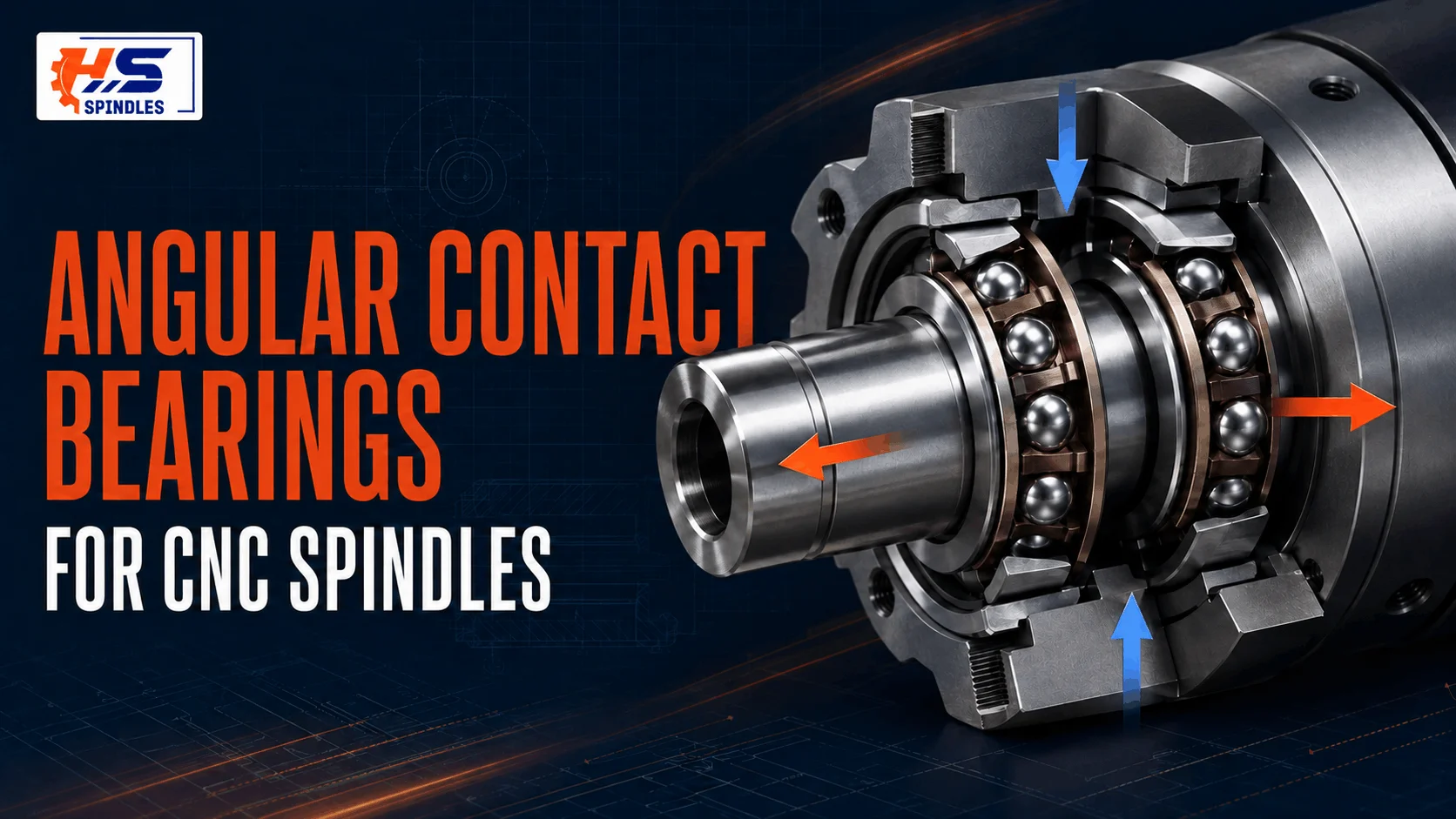
Angular contact bearings are the precision bearings that support the rotating shaft inside every CNC spindle. Unlike standard radial bearings, angular contact bearings are designed to handle combined radial and axial (thrust) loads simultaneously — the combination of forces that spindles generate at speed and under cutting load.
Selecting the right angular contact bearings for your CNC spindle determines how long it runs, how precisely it cuts, and when it will next need service.
What Makes Angular Contact Bearings Different?
A standard deep-groove ball bearing handles radial loads well but cannot effectively handle axial loads — forces along the axis of rotation. A CNC spindle under cutting load receives both simultaneously: radial force from the cutting tool pushing sideways, and axial force from the tool being pushed into the workpiece.
Angular contact bearings resolve this by positioning the balls at an angle — the contact angle — between the inner and outer races. This angle (typically 15°, 25°, or 40°) allows the bearing to carry both radial and axial loads in proportion to its geometry. Higher contact angles handle more axial load; lower angles handle more radial load at higher speeds.
Key Specifications to Understand
Contact Angle
- 15°: High-speed applications, moderate axial load capacity. Common in woodworking spindles.
- 25°: Balanced performance. The most common contact angle for CNC routing spindles.
- 40°: High axial load capacity at lower speeds. Used in grinding and milling applications.
Preload Grade
Preload is a controlled compressive load applied to the bearing during installation. It eliminates internal clearance and ensures the bearing elements maintain contact under all load conditions.
| Preload Grade | Designation | Application |
| Light | C, CL, GL | High-speed routing, minimal cutting load |
| Medium | CM, GM | General machining, CNC routing |
| Heavy | CH, GH | Heavy milling, grinding, high cutting force |
Important: Never substitute a heavier preload than specified — excess preload generates heat and dramatically shortens bearing life. Never substitute a lighter preload — the spindle will run with internal play, producing vibration and poor surface finish.
Precision Grade (ISO 492 / ABEC)
CNC spindle bearings are supplied to precision grades that define the tolerances on geometric accuracy:
| ISO Grade | ABEC Equivalent | Typical Application |
| P5 / ABEC 5 | Standard precision | General CNC routing |
| P4 / ABEC 7 | High precision | HSD, Hiteco, most CNC spindles |
| P2 / ABEC 9 | Ultra-precision | GMN, Setco, grinding spindles |
Always replace spindle bearings with the same or higher precision grade as the originals. Fitting a P5 bearing where a P4 was fitted will result in measurably worse runout.
Steel vs Ceramic Hybrid Bearings
All-Steel Angular Contact Bearings
Standard CNC spindle bearings use all-steel construction for both the rings and the balls. This is appropriate for most CNC routing and machining applications up to approximately 18,000–24,000 RPM.
Ceramic Hybrid Bearings
Hybrid ceramic bearings use steel rings with silicon nitride (Si3N4) ceramic balls. The ceramic balls offer:
- Lower density (40% lighter than steel) ® less centrifugal force at speed
- Higher surface hardness ® longer wear life
- Lower thermal expansion ® more stable preload at temperature
- Non-conductive ® electrical isolation useful in some motor spindles
- Higher maximum speed (DN values typically 20–40% higher than steel)
Ceramic hybrid bearings are required for GMN spindles and recommended for any spindle running above 24,000 RPM. They cost more than steel bearings but last significantly longer in high-speed applications.
Brands We Use at HS Spindles
We select super-precision angular contact bearings from the following manufacturers for all spindle rebuilds:
- SKF — Superior precision and proven longevity in CNC routing applications
- FAG / Schaeffler — Excellent range for HSD, Hiteco, and machining centre spindles
- NSK — Strong range for Fanuc, Mazak, and precision machining spindles
- NTN — Reliable for routing and mid-range machining applications
We do not use unbranded or unrated bearings in any rebuild, regardless of cost pressure.
Which Bearings Fit Which Spindle Brands?
While specific bearing sizes require your spindle model number, the general specifications by brand are:
| Spindle Brand | Typical Bore Size | Contact Angle | Ball Type | Preload |
| HSD ES series | 30–55mm | 25° | Steel | Medium |
| Hiteco QE/QT | 30–50mm | 25° | Steel | Medium |
| GMN TSSV | 17–30mm | 15° | Ceramic | Light |
| GMN HCS | 25–40mm | 25° | Ceramic | Light–Medium |
| Setco grinding | 40–80mm | 15–25° | Steel | Heavy |
| Fanuc alpha | 40–60mm | 25° | Steel | Medium |
For exact specification matching, provide your spindle model number. We can identify the correct bearing set and supply it.
How Often Should CNC Spindle Bearings Be Replaced?
There is no fixed time interval — bearing life depends on operating speed, load, lubrication quality, contamination control, and temperature management. General guidelines:
- CNC routing spindles (HSD, Hiteco): 8,000–15,000 operating hours with proper maintenance
- High-speed spindles (GMN): 5,000–10,000 hours
- Grinding spindles (Setco): 2,000–6,000 hours depending on grinding forces
- Machining centre spindles (Fanuc): 10,000–20,000 hours
The best indicator is condition, not age. Increasing operating temperature, rising vibration levels, or measurable change in runout are the actual signals to replace.
DIY Bearing Replacement vs Professional Rebuild
Bearing replacement in a CNC spindle is not a standard maintenance task — it requires:
- A clean, temperature-controlled assembly environment
- Calibrated torque tooling to set bearing preload correctly
- A dynamic balancing machine to certify the rebuilt spindle
- A precision runout testing fixture
Attempting bearing replacement without this equipment typically results in either incorrect preload (generating heat and premature failure) or re-contamination during assembly. We strongly recommend professional rebuild for any spindle requiring bearing replacement.
Frequently Asked Questions
What are angular contact bearings used for in CNC spindles?
Angular contact bearings support the rotating shaft of a CNC spindle against both radial and axial loads generated during cutting. Their angled ball contact geometry allows them to handle combined loads that standard radial bearings cannot manage at spindle operating speeds.
How do I know what bearing my spindle needs?
You need the spindle manufacturer’s part number or model number. The bearing specification (bore size, outside diameter, width, contact angle, preload grade, precision grade, and ball material) must match the original exactly. Call us at +1 714-307-2332 with your spindle model number and we will identify the correct bearing set.
Can I replace spindle bearings myself?
Technically possible, but strongly not recommended without a dynamic balancing machine and precision runout measurement equipment. Incorrect bearing preload is the most common cause of early bearing failure after replacement. Professional rebuild is the reliable option.
Are ceramic bearings worth the extra cost?
Yes, for spindles running above 24,000 RPM or in applications with frequent thermal cycling. The reduced centrifugal force, longer wear life, and higher speed capability of ceramic hybrid bearings deliver a better long-term cost per hour than steel bearings in high-speed applications.
Shop Angular Contact Bearings
Send your spindle for professional rebuild ®
■ +1 714-307-2332

