
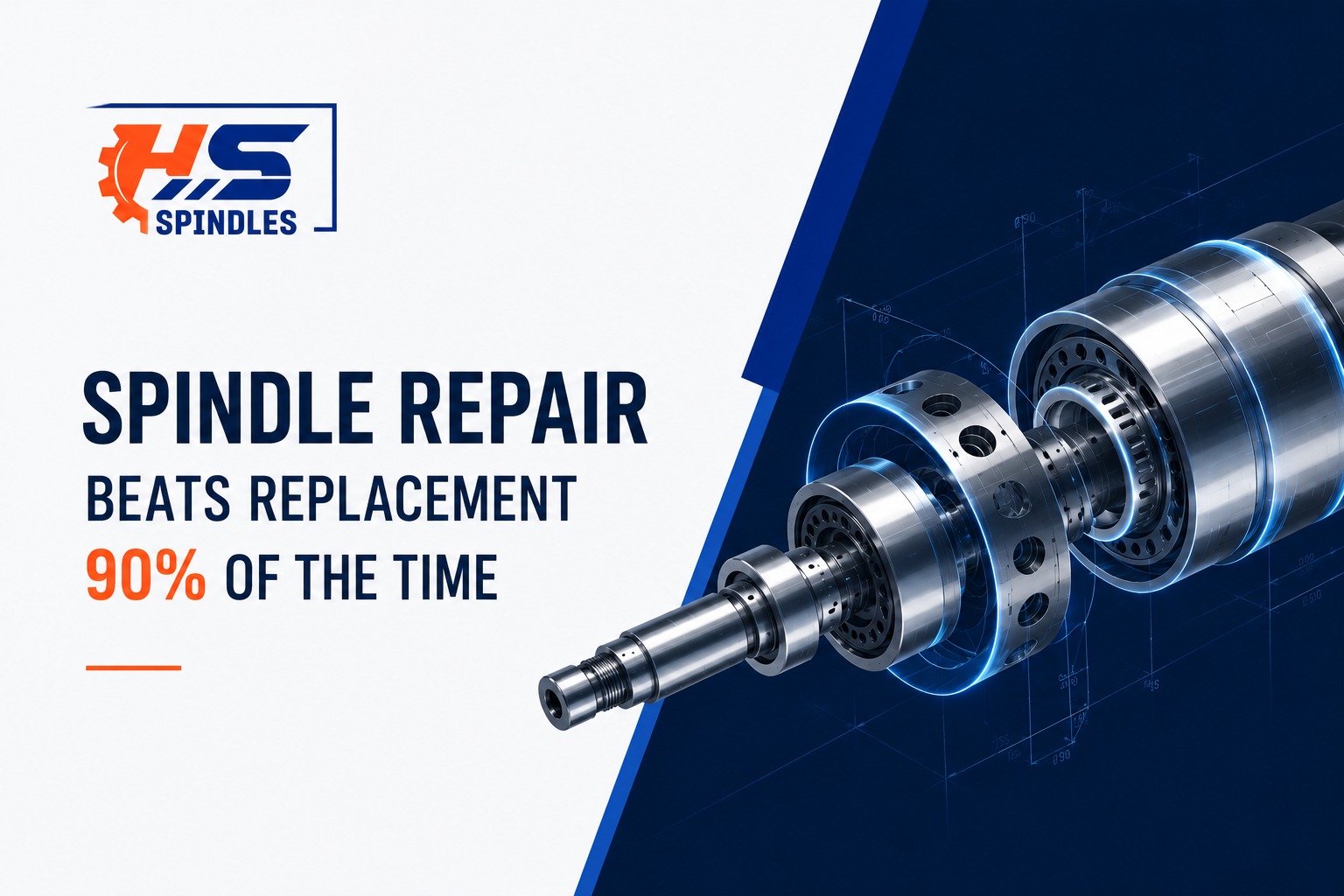
When a CNC spindle starts acting up — strange vibrations, unusual noise, overheating, or sudden loss of precision — the first thought that crosses most shop managers’ minds is: “How fast can we get a replacement?” It’s an understandable reaction. Downtime is expensive, pressure is high, and replacing feels like the clean, simple solution.
But here’s what years of hands-on experience in spindle repair tells us: replacement is rarely the right answer right away. In fact, the overwhelming majority of spindle failures — we’re talking roughly 9 out of 10 cases — are fully recoverable through professional repair. The spindle doesn’t need to be thrown out. It needs to be properly diagnosed and rebuilt by engineers who know what they’re doing.
So before you sign off on a five-figure purchase order for a new spindle, let’s walk through why spindle repair almost always deserves to be your first call.
What’s Actually Going Wrong Inside Your Spindle
A CNC spindle is a precision-engineered assembly. At its heart, you’ve got bearings, a shaft, a motor (in the case of motorized electrospindles), a tool clamping mechanism, and a lubrication system — all working in extremely tight tolerances at speeds that can exceed 20,000 RPM.
When something fails, it’s usually not the entire spindle that’s gone. The most common culprits are:
- Bearing failure — contamination, improper lubrication, or overloading
- Shaft damage — bending or scoring from tool crashes or overuse
- Motor winding issues — in integrated motor spindles
- Seal degradation — allowing coolant or dust into the bearing cavity
- Tool clamping wear — reducing grip force and causing runout
Each of these is a repairable condition. A trained spindle repair technician can disassemble the unit, identify the root cause, replace worn components, and return the spindle to OEM performance standards — often for a fraction of what a brand-new unit would cost.
The Real Cost of Replacement vs. Spindle Repair
Let’s be direct about the numbers. Depending on your spindle type and manufacturer, a replacement spindle can run anywhere from $8,000 to well over $40,000. For high-speed HSD or similar electrospindles used in woodworking, composite machining, or aluminum processing, that number climbs fast.
Professional spindle repair, by contrast, typically runs 20% to 50% of the replacement cost — sometimes less. For a $20,000 spindle, that’s a potential savings of $10,000 to $16,000 on a single repair event.
Then there’s lead time. Ordering a new OEM spindle often means waiting anywhere from four to twelve weeks, sometimes longer if it’s a specialty unit. A reputable spindle repair shop can typically turn around a standard rebuild in one to three weeks — and many offer expedited services for critical production situations.
Every day your machine sits idle has a real dollar cost. If your shop runs one machine that generates $2,000 per day in output, an extra six weeks waiting for a replacement spindle translates to $84,000 in lost production — on top of the cost of the spindle itself. Repair almost always gets you back online faster.
What Professional Spindle Repair Actually Looks Like
A lot of people picture spindle repair as a basic fix — swap some bearings, slap it back together. That’s not how serious spindle repair works, and it’s worth understanding the difference between a proper rebuild and a patch job.
At HS Spindles, for example, every repair starts with a full diagnostic evaluation. The spindle is completely disassembled, every component is inspected, and the root cause of failure is identified before any parts are ordered or installed. This matters because treating symptoms without addressing root causes leads to repeat failures.
Checkout our repair process
The rebuilding process involves:
Precision bearing replacement. High-quality angular contact bearings — such as GMN-certified bearings that meet or exceed OEM specs — are installed with correct preload. Bearing preload is critical; too loose and you get vibration, too tight and you generate excessive heat. This is not something you eyeball.
Shaft inspection and reconditioning. The spindle shaft is measured for runout and inspected for surface damage. Minor scoring or wear can often be corrected. Severe crashes may require shaft replacement.
Dynamic balancing. Once reassembled, the spindle is dynamically balanced at full operating speed — ideally to 0.3 G’s or better. An improperly balanced spindle will destroy new bearings within weeks and create surface finish problems in your parts.
Full performance testing. Before a repaired spindle ships, it should be run-tested at operating speed to confirm vibration levels, temperature stability, and tool clamping function are all within spec.
This is the difference between a spindle repair that lasts years and one that fails again in three months.
When Does Replacement Actually Make Sense?
To be fair, spindle repair isn’t the answer in every single situation. There are legitimate cases where replacement is the better path:
The spindle is obsolete. If replacement parts are no longer manufactured for your spindle model and the existing components are beyond salvage, repair may not be feasible.
Catastrophic physical damage. A severe crash that bends the housing, destroys the shaft beyond reconditioning, or damages the motor stator and rotor beyond rewinding may total the unit.
Repeated failures of the same type. If a spindle has been repaired multiple times for the same issue, it may point to an application mismatch or a machine problem that keeps damaging the spindle. In that case, upgrading to a more suitable spindle model makes more sense than continuing to repair.
Upgrading capacity intentionally. Sometimes a shop isn’t replacing a failed spindle — they’re investing in higher RPM, greater power, or different toolholding interface because the work has changed. That’s a planned upgrade, not an emergency replacement.
Outside these scenarios, the odds strongly favor repair over replacement — which is where that 90% figure comes from. It’s not a sales pitch. It’s the reality of what a qualified spindle repair technician sees across hundreds of repair cases each year.
Choosing the Right Spindle Repair Partner
Not all spindle repair shops are equal, and the quality of work varies significantly. When evaluating a spindle repair provider, here’s what to look for:
Experience with your spindle brand and type. Whether you’re running BT, ISO, CAT, or HSK spindles, or working with manufacturers like HSD, Hiteco, or other brands, your repair shop should have documented experience with your specific configuration.
OEM-quality parts. Ask specifically what bearings and components they use. Shops that use generic, low-grade bearings to cut costs are setting you up for early failure. GMN bearings and other recognized precision bearing manufacturers are what you want to see.
Dynamic balancing capability. This is non-negotiable for high-speed spindles. Any shop that skips this step is cutting a corner that will cost you later.
Clear warranty terms. A confident repair shop stands behind their work with a meaningful warranty. Vague or very short warranty periods are a red flag.
Transparent turnaround times. Good shops give you honest lead times and communicate proactively. Look for shops that offer expedited options when you’re in a production crunch.
At HS Spindles, we’ve been rebuilding and servicing high-speed spindles for CNC machines across aerospace, automotive, woodworking, and composites industries. Our process covers everything from full spindle rebuild and dynamic balancing to cartridge repair and HSD-specific services — and every repaired spindle leaves our shop tested, balanced, and ready to perform.
The next time your CNC spindle gives you trouble, resist the instinct to immediately order a replacement. Get a proper diagnosis first. In most cases, what looks like a catastrophic failure is actually a recoverable condition — one that a skilled spindle repair team can address at a fraction of the replacement cost, in less time, and with results that match or exceed OEM performance.
Spindle repair isn’t the second-best option. Done right, it’s the smart option.
Ready to get your spindle evaluated? Contact HS Spindles at hsspindles.com or call us at +1 714-307-2332. We’ll give you an honest assessment and get you back to cutting parts as fast as possible.

