
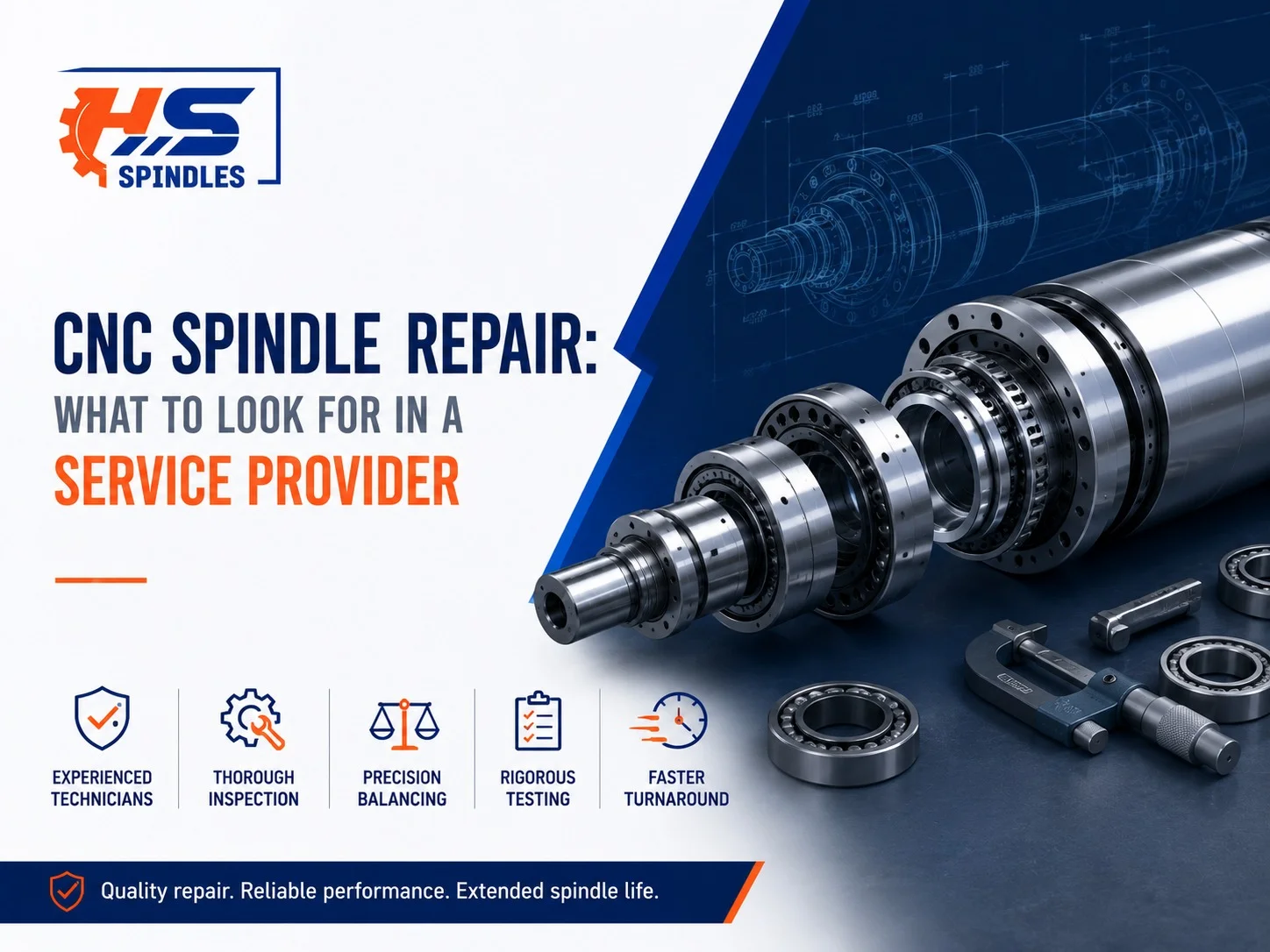
You’ve got a spindle down. The machine is idle. Every hour it sits is money walking out the door.
The last thing you need in that moment is to hand your spindle to the wrong shop — get it back weeks later, run it for three months, and watch it fail again.
It happens more often than most shop managers want to admit. And it doesn’t happen because spindle repair is impossible to do well. It happens because not every shop that calls itself a “spindle repair specialist” actually is one.
This guide is about helping you tell the difference — before you ship anything out.
The Problem With How Most People Choose a Spindle Repair Shop
Most shops pick a spindle repair provider the same way they’d pick a plumber. They search online, call whoever comes up first, ask about price and turnaround, and go with the one that sounds reasonable.
That works fine for a leaky tap. It’s a risky strategy for a precision component spinning at 24,000 RPM inside a machine worth hundreds of thousands of pounds.
CNC spindle repair is a highly specialised discipline. The tolerances involved are measured in microns. A bearing installed with even slightly incorrect preload will fail prematurely — and when it goes, it often takes other components with it. Dynamic balancing done to the wrong spec causes vibration that destroys surface finish and eats tooling. A seal fitted improperly lets coolant into the bearing cavity and the whole assembly is compromised within weeks.
The difference between a proper repair and a poor one isn’t always visible at handover. It shows up three months later, mid-production run, at the worst possible time.
So what should you actually be looking for?
Contact us for CNC repair
1. Genuine Experience With Your Spindle Type — Not Just “Spindles in General”
The first question to ask any spindle repair provider is simple: have you worked on this exact spindle configuration before?
There’s a meaningful difference between a shop that can rebuild a generic belt-drive spindle and one that has documented experience with HSK 63F electrospindles, or HSD integrated motor spindles, or Hiteco units running at 24,000 RPM in a point-to-point router.
Spindle architecture varies significantly between manufacturers. The bearing arrangements differ. The preload methods differ. The assembly sequences and torque specifications differ. A technician who has rebuilt hundreds of BT30 spindles for machining centres is not automatically qualified to rebuild a high-speed woodworking electrospindle — even if the fundamental principles are the same.
Ask specifically. If they hesitate, or if their answer is vague (“we work on all types”), push for examples. A shop with genuine experience will be able to tell you exactly what they’ve seen on that platform — common failure modes, typical root causes, specific parts they stock.
What to ask:
- What spindle brands and configurations do you most commonly service?
- Have you worked on this exact model before?
- What’s the most common failure you see on this type of spindle?
2. A Proper Diagnostic Process — Not Just a Repair Quote
Here’s a red flag that’s easy to miss: a shop that gives you a repair quote before they’ve even looked at the spindle.
A reputable spindle repair provider will not commit to a fixed repair scope until the spindle has been fully disassembled and inspected. The reason is straightforward — you genuinely cannot know the extent of damage from external symptoms alone. What presents as a vibration issue could be a bearing gone, a shaft with runout, contamination in the bearing cavity, or a preload that’s drifted over time. Sometimes it’s all four.
The right process starts with a full incoming inspection: runout measurement, vibration analysis, visual assessment, and for motorised spindles, electrical testing of the winding. Only after the spindle is fully disassembled and every component is measured against OEM tolerances should a definitive repair scope — and cost — be confirmed.
If a shop skips this step and commits to a price upfront, they’re either guessing, or they’re planning to do a minimum-effort job regardless of what they find inside.
What to ask:
- Do you disassemble and inspect before quoting?
- What does your diagnostic process involve?
- Will I receive an inspection report before approving work?
3. Premium Components — Especially Bearings
Bearings are the single most important component in a spindle rebuild. They are also the easiest place for a cost-cutting shop to quietly downgrade without you ever knowing.
The difference between a high-quality angular contact bearing from a manufacturer like GMN, FAG, or SKF and a generic equivalent might be fifty to a hundred pounds per bearing. In a spindle that takes four or six bearings, that’s a few hundred pounds of savings for the shop — and potentially thousands of pounds in repeat failures for you.
Ask explicitly what bearings they use. Ask for the manufacturer name. If they’re vague, or if they say “equivalent” or “comparable” without naming a specific brand, that’s a warning sign.
The same principle applies to seals, O-rings, and labyrinth components. These protect your bearings from coolant and contamination. Cheap seals fail faster. When they fail, they let coolant into the bearing cavity and the whole rebuild is compromised. There is no such thing as a false economy on seal quality in a spindle repair.
What to ask:
- What bearing brands do you use? Can you show me the spec sheet?
- Do you use OEM-spec or better components throughout?
- What’s your policy on using generic parts?
4. In-House Dynamic Balancing — At Full Operating Speed
This is non-negotiable, and it’s where a surprising number of shops fall short.
Dynamic balancing is the process of measuring and correcting the rotational balance of the assembled spindle. At the speeds CNC spindles operate — often between 12,000 and 40,000 RPM — even a small imbalance creates centrifugal forces that are orders of magnitude greater than the imbalance itself. A spindle that isn’t properly balanced will vibrate. That vibration degrades surface finish, accelerates bearing wear, and shortens tool life.
The key word is dynamic. Static balancing — checking balance at rest — is not adequate for high-speed spindles. The spindle needs to be balanced while rotating, at or near its operating speed, using purpose-built balancing equipment.
Ask whether they have this capability in-house. If they send spindles out for balancing, that’s an extra step, extra handling, extra delay — and potentially less accountability. The best shops balance every spindle internally as a standard part of the rebuild process.
Also ask what balance standard they work to. A reputable shop will give you a specific figure — something like 0.3 G’s or better, or reference to ISO 1940 balance grades. If the answer is “we balance it” without any specifics, press harder.
What to ask:
- Do you balance spindles in-house?
- At what speed do you balance, and what standard do you balance to?
- Is balancing included as standard, or is it an add-on?
5. Full Performance Testing Before Dispatch
A rebuilt spindle should be run, measured, and verified — not just assembled and shipped.
The minimum you should expect before your spindle leaves the repair facility:
- Runout measurement — axial and radial, at the tool interface
- Vibration analysis — across the full operating speed range, not just at idle
- Thermal monitoring — temperature checked during run-in to confirm bearings are running cool
- Drawbar force testing — for automatic tool change spindles, clamping force verified to spec
Ask whether you’ll receive documented test results with the spindle. This matters for two reasons. First, it tells you the shop actually did the testing rather than just saying they did. Second, it gives you a baseline — if the spindle later develops issues, you can compare current measurements against the post-rebuild figures and identify what’s changed.
Shops that test thoroughly are also shops that stand behind their work. The documentation is evidence of accountability.
What to ask:
- What performance tests do you run before dispatch?
- Will I receive a written test report with the spindle?
- What vibration levels and runout figures should I expect?
6. Honest, Specific Warranty Terms
Every decent spindle repair shop offers a warranty. What matters is what that warranty actually covers, for how long, and under what conditions.
Be wary of very short warranty periods — anything under three months on a full rebuild deserves scrutiny. Be equally wary of warranties that are heavily hedged with exclusions, or that require you to return the spindle for inspection before any claim is considered.
A shop that does good work is not afraid to stand behind it. The warranty should cover workmanship and component failure for a reasonable period, and the terms should be written down and provided to you before you approve the work.
Also ask what the process is if something goes wrong. Do they collect the spindle? Who covers freight? How quickly will they turn it around? A warranty is only as good as the process behind it.
What to ask:
- What does your warranty cover, and for how long?
- What’s excluded?
- What’s the process if I need to make a claim?
7. Clear Communication and Realistic Turnaround Times
This one sounds obvious, but it eliminates a surprising number of providers.
A good spindle repair shop tells you the truth about lead times — even when that truth is inconvenient. They tell you upfront if they’re at capacity. They give you a realistic timeframe, stick to it, and contact you proactively if something changes.
What you want to avoid is a shop that quotes an optimistic turnaround to win the job, then goes quiet for two weeks before telling you they’re waiting on a part that was never in stock.
If you’re in a production-critical situation, ask specifically whether expedited service is available, what that actually means in practice (faster queue position? dedicated technician? weekend work?), and what it costs. A shop that offers genuine expedited options has the capacity and organisation to deliver on that promise.
What to ask:
- What’s your current lead time on a standard rebuild?
- Do you offer expedited service, and what does that involve?
- How do you communicate progress during the repair?
The Difference Between Cheap and Good Value
The lowest quote is rarely the best option for CNC spindle repair — but that doesn’t mean you should be paying over the odds either.
Good value in spindle repair means a thorough job, with premium components, proper balancing and testing, honest communication, and a warranty that means something. That job, done properly, should cost significantly less than a new spindle — typically 30 to 60 percent of replacement cost — and should return your machine to full performance for a long service life.
A cheap repair that fails in three months isn’t a bargain. It’s the full cost of the repair, plus downtime, plus the cost of a second repair, plus the risk of consequential damage to your machine. When you add it up, the cost of doing it wrong is always higher than the cost of doing it right.
What Sets HS Spindles Apart
At HS Spindles, we built the business around one simple principle: do the job properly, every time, regardless of how much easier it would be to cut corners.
That means full disassembly and diagnostic inspection before any quote is confirmed. Premium angular contact bearings — GMN-certified — installed with precision preload techniques. Dynamic balancing in-house to 0.3 G’s or better. Documented test results with every spindle. And warranty terms that are written down and actually mean something.
We work across HSK, ISO, BT, CAT, and Hiteco spindle platforms, serving manufacturers in aerospace, automotive, woodworking, composites, and oil and gas. We’re a veteran-owned operation, and that shapes how we work — methodically, accountably, and without cutting corners.
If your spindle is down, or if you want to get ahead of a failure before it happens, we’re straightforward to reach.
📞 +1 714-307-2332 ✉ engineering@hsspindles.com 🌐 hsspindles.com
Contact us for CNC repair

