
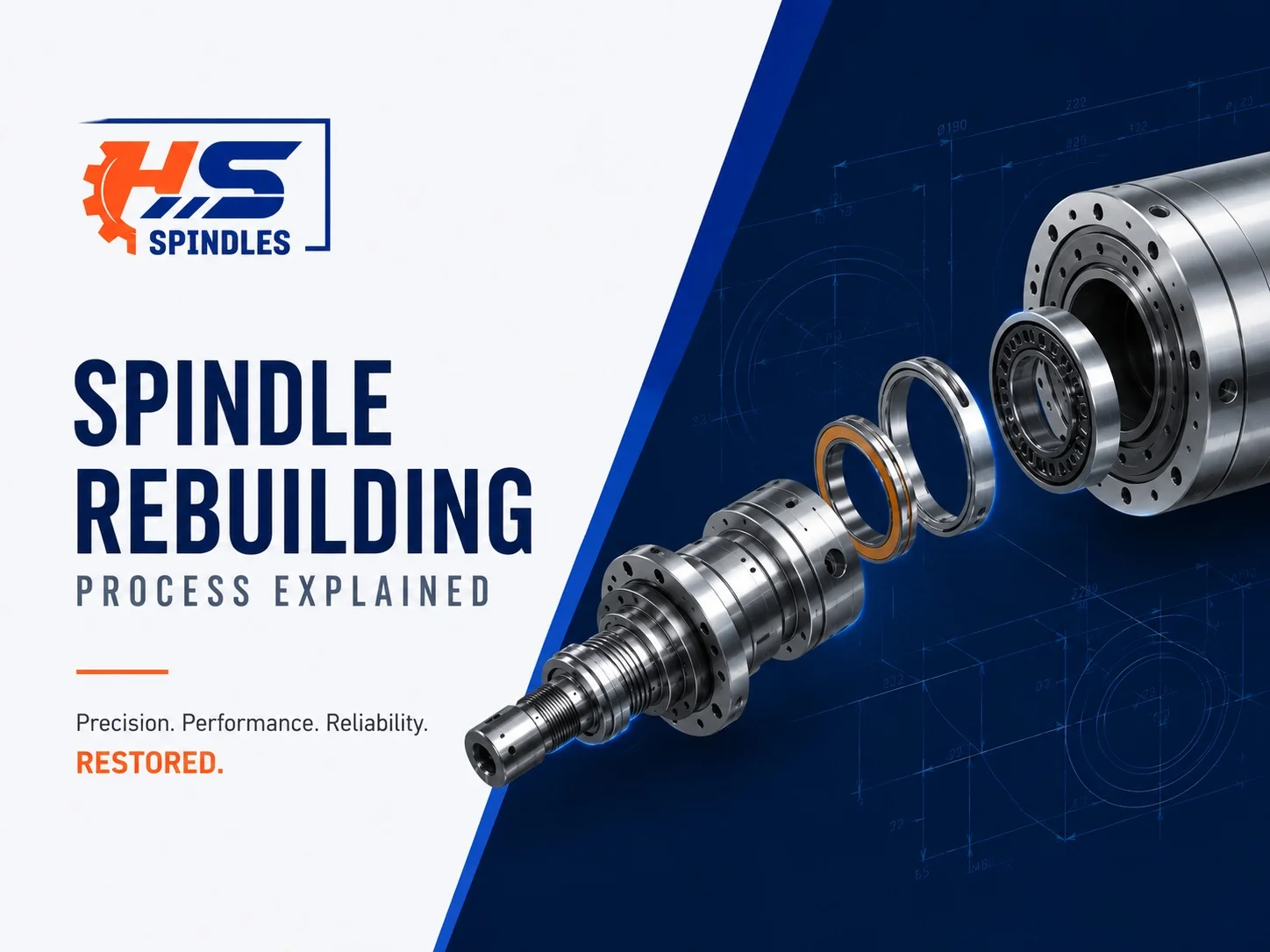
Your CNC machine has started vibrating more than usual. Surface finishes are getting worse. Tolerances are slipping. Before you budget for a brand-new spindle, there’s a smarter option most shop owners overlook — a professional spindle rebuild.
A spindle rebuild can restore your machine to factory-level performance at a fraction of the cost of replacement. But what exactly does the process involve? What happens inside the shop when your spindle gets rebuilt? And how do you know if a rebuild is even the right call?
This guide breaks it all down — step by step.
What Is a Spindle Rebuild?
A spindle rebuild — sometimes called spindle reconditioning or spindle remanufacturing — is the process of completely disassembling a worn or damaged CNC spindle, replacing all critical internal components, and reassembling it to OEM (Original Equipment Manufacturer) specifications.
Unlike a basic spindle repair, which addresses a specific failure or component, a full rebuild is a comprehensive overhaul. Every bearing, seal, and internal part is inspected. Worn components are replaced. The spindle is tested to meet — and in many cases exceed — its original performance ratings.
Think of it like rebuilding a car engine. You’re not just patching the problem — you’re restoring the whole system.
Spindle Repair vs. Spindle Rebuild: What’s the Difference?
Many people use these terms interchangeably, but they’re not the same thing.
Spindle Repair fixes a specific problem — a failed bearing, a burnt winding, or a damaged drawbar. It’s fast and cost-effective for isolated failures.
Spindle Rebuild is a complete overhaul. All wear components are replaced regardless of visible damage. It’s the right call when the spindle has high run-hours or has suffered significant performance degradation over time.
If your spindle has multiple issues or has been running for years without service, a rebuild is usually the better long-term investment.
Signs You May Need a Spindle Rebuild
Watch for these warning signals before your spindle fails completely:
- Excessive vibration or chatter, even at normal cutting speeds
- Degraded surface finish quality on machined parts
- Burning smell or abnormal heat coming from the spindle housing
- Unusual noise — grinding, squealing, or rumbling during operation
- Loss of accuracy or repeatability in part dimensions
- Increased tool wear with no change in cutting parameters
- High run hours (typically 10,000–20,000+ hours depending on the spindle)
Catching these signs early means the difference between a cost-effective rebuild and a catastrophic failure that could damage your machine’s spindle housing or tooling system.
The Full Spindle Rebuild Process — Step by Step
At HS Spindles, every rebuild follows a rigorous, proven process. Here’s exactly what happens:
Step 1: Initial Inspection & Evaluation
When your spindle arrives at our facility, our technicians start with a thorough incoming inspection. We document the spindle’s make, model, serial number, and reported symptoms. We then run diagnostic tests — checking runout, vibration signature, and electrical resistance (for motorized spindles) — to understand the full scope of damage before a single bolt is turned.
Step 2: Complete Disassembly
The spindle is completely disassembled in a climate-controlled, contamination-free environment. This is critical — even microscopic debris can compromise bearing performance. Every component is laid out, labeled, and documented with photographs. Nothing is assumed to be good until it’s been verified.
Step 3: Component Inspection & Measurement
Each component is measured to precise tolerances using calibrated instruments. The shaft is checked for runout and straightness. The housing bore is measured for roundness and surface condition. The drawbar, tool interface (HSK, ISO, or BT), and preload spacers are all evaluated against OEM specifications.
Step 4: Bearing Replacement
Bearings are the heart of a spindle — and they’re always replaced in a full rebuild, regardless of their apparent condition. We use premium angular contact bearings from trusted manufacturers like GMN, which meet or exceed OEM specifications.
Bearings are installed with the correct preload using precision spacers and controlled techniques. Improper preload is one of the most common causes of premature spindle failure — too little and the spindle loses accuracy; too much and the bearings overheat and fail early.
Step 5: Shaft & Housing Reconditioning
If the shaft shows wear, scoring, or corrosion, it is reconditioned through precision grinding or plating to restore it to OEM dimensions. The housing may also be honed to correct bore geometry. This step ensures that the new bearings seat perfectly and the spindle runs true.
Step 6: Seal & Labyrinth Replacement
All seals, O-rings, and labyrinth components are replaced. These components protect the spindle’s internal bearings from coolant, chips, and debris — the enemies of spindle longevity. Using worn seals is a shortcut no reputable rebuild shop should take.
Step 7: Reassembly to OEM Specifications
The spindle is reassembled in a clean-room environment by experienced technicians. Torque specifications, preload settings, and assembly sequences follow OEM guidelines exactly. Every fastener is torqued to spec. Every component is installed with the care and precision that high-speed rotation demands.
Step 8: Dynamic Balancing
After assembly, every rebuilt spindle is dynamically balanced at full operating speed. At HS Spindles, we balance to 0.3 G’s or better — a standard that ensures smooth, vibration-free operation and protects your machine tool, tooling, and workpiece quality.
Dynamic balancing is non-negotiable for high-speed spindles. Even a tiny imbalance at 18,000 RPM creates centrifugal forces that rapidly degrade bearings and produce measurable error in part quality.
Step 9: Final Testing & Quality Control
Before the spindle ships back to you, it undergoes a full battery of performance tests:
- Runout measurement (axial and radial)
- Vibration analysis across the full speed range
- Temperature monitoring during run-in
- Load testing under simulated cutting conditions
- Drawbar clamping force verification (for ATC spindles)
Every spindle leaves our facility with documented test results. You receive a spindle that has been proven — not just assembled.
How Long Does a Spindle Rebuild Take?
Standard spindle rebuild turnaround at HS Spindles is typically 5–10 business days, depending on the spindle type and parts availability. For customers facing critical production downtime, we offer expedited spindle repair and rebuild services to get you back running as fast as possible.
We also maintain an inventory of exchange and refurbished spindles for common models — so in some cases, you can have a fully rebuilt spindle in hand the next day.
What Does a Spindle Rebuild Cost?
Spindle rebuild costs vary based on the spindle type, size, speed rating, and the extent of damage. As a general benchmark, a professional rebuild typically runs 30–60% of the cost of a new spindle — often saving manufacturers thousands of dollars per unit.
At HS Spindles, we provide a detailed inspection report and rebuild quote before any work begins. You’ll know exactly what’s being done and what it costs — no surprises.
Why Choose a Professional Spindle Rebuild Shop?
Spindle rebuilding is not a DIY operation. The tolerances involved are measured in microns. The speeds involved — often 18,000 to 40,000 RPM — leave zero room for error. An improperly rebuilt spindle can fail catastrophically, damaging your machine and creating serious safety hazards.
A professional rebuild shop brings:
- Precision measurement equipment and clean-room assembly environments
- Certified technicians with hands-on spindle expertise
- Access to OEM-quality or better replacement bearings and components
- Dynamic balancing equipment capable of full operating speed testing
- Documented quality control and warranty on the rebuild work
HS Spindles is a veteran-owned repair and rebuild facility with years of hands-on experience across HSK, ISO, BT, CAT, and Hiteco spindle platforms. We service spindles for aerospace, automotive, oil & gas, and general manufacturing customers across the US and India.
Ready to Rebuild Your Spindle? Talk to the Experts.
Don’t let a worn spindle slow down your production. Whether you’re dealing with vibration, accuracy loss, or a complete failure, HS Spindles has the expertise and equipment to get you back to full performance — fast.
📞 +1 714-307-2332 ✉ engineering@hsspindles.com 🌐 hsspindles.com/repair/spindle-repair
HS Spindles — Precision, Performance, Reliability

