
Walk into almost any spindle repair shop’s website and you’ll see the same words: precision, quality, performance, expertise.
What you won’t see is what any of that actually means. What tolerances are they working to? What runout figure is acceptable off the bench? How do they verify the spindle is genuinely performing before it goes back in your machine?
The answer, in most cases, is that they don’t say — because precision in spindle repair is harder to fake when you put numbers to it.
This article is about the numbers. It’s about what tolerances actually govern spindle performance, what runout means in practice and why it matters, and what separates a repair that lasts from one that looks fine at handover and fails six months down the line.
First, Why Precision Matters More in Spindle Repair Than Almost Anywhere Else
A CNC spindle is not like most mechanical components. It operates at speeds that can exceed 40,000 RPM. The forces generated at those speeds are not linear — they scale with the square of rotational speed, which means doubling the RPM quadruples the centrifugal load.
At those speeds, the margin for error is measured not in millimetres, not in hundredths of a millimetre, but in microns. One micron is one thousandth of a millimetre. A human hair is approximately 70 microns thick. The tolerances that govern precision spindle repair sit well within that range.
When a repair is done imprecisely — when bearings are installed with the wrong preload, when a shaft with marginal runout is returned to service, when a spindle is balanced to an adequate rather than excellent standard — the consequences don’t always show up immediately. They show up gradually, in slightly degraded surface finish, in tool life that’s a little shorter than it used to be, in dimensions that drift over long production runs. And then, eventually, they show up as a failure.
Precision spindle repair means getting the numbers right. Here’s what those numbers are.
Runout: The Number That Defines Spindle Accuracy
Runout is the most important single measurement in spindle performance. It is also one of the most commonly misunderstood.
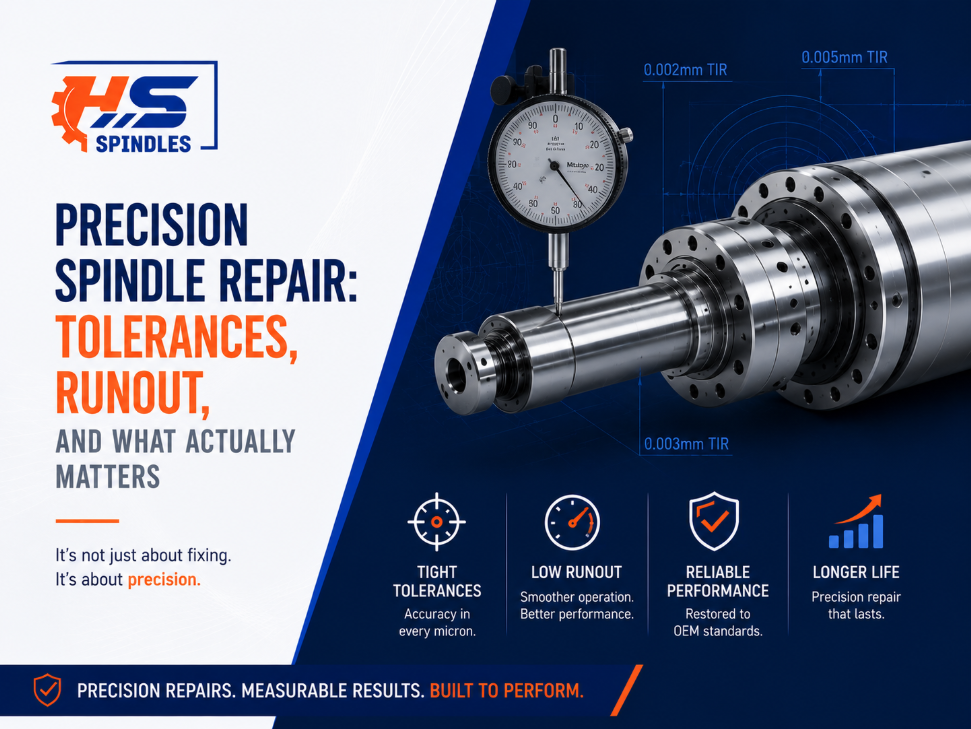
Runout is the deviation of a rotating surface from true circular motion. When a spindle shaft rotates, the centreline of that rotation should stay perfectly fixed in space. Runout is the measurement of how far it doesn’t.
There are two types:
Radial runout measures how much the shaft moves side to side as it rotates — essentially, how far the centreline wobbles in the horizontal or vertical plane. In a milling spindle, radial runout at the tool interface directly translates to positional error in your cut.
Axial runout measures how much the shaft moves along its own axis as it rotates — a slight in-and-out motion. In a drilling or boring application, axial runout translates directly to depth variation.
What Are Acceptable Runout Figures?
This is where precision spindle repair separates from adequate spindle repair.
For general-purpose machining spindles, a runout of 2–5 microns at the tool interface is considered acceptable. For high-precision applications — tight-tolerance boring, fine surface finishing, aerospace components — the target is 1–2 microns or better.
For reference: a surface finish error of even 1 micron is detectable by measurement, and in high-value components, it matters.
A repair shop doing precision work should be able to tell you exactly what runout figure the spindle measured when it left their facility. That figure should be documented. If a shop can’t give you a number — if the answer is “it’s within spec” without a spec being stated — that is not precision spindle repair. That’s reassurance.
What Causes Runout?
Understanding the causes of runout is important because it tells you where in the repair process accuracy is won or lost.
Bearing quality and installation. Angular contact bearings for precision spindles have their own internal tolerances — typically P4 or P2 grade, which correspond to increasingly tight dimensional standards. A P4-grade bearing has tighter geometry than a standard bearing. Installing a standard bearing in a precision spindle application introduces runout from the outset. This is a common cost-cutting shortcut.
Bearing preload. Correct preload keeps the bearing elements in the correct geometric relationship during operation. Insufficient preload allows the bearing elements to move, increasing runout dynamically — meaning the spindle runs fine at low speed but develops runout as speed increases and the bearing clearances change under load. Excessive preload generates heat, which also changes bearing geometry and introduces runout.
Shaft geometry. A shaft that has been bent — even slightly — by a tool crash or by years of heavy cutting will run with inherent runout that no amount of bearing precision can correct. Shaft runout must be measured before assembly, and if it falls outside tolerance, the shaft must be reconditioned or replaced.
Housing bore condition. The housing bore that the outer bearing race presses into must be round, cylindrical, and dimensionally correct. An out-of-round bore loads the bearing unevenly, distorts the outer race, and introduces runout that wasn’t present in the components individually.
Bearing Tolerances: Where the Money Gets Spent (or Saved)
Bearings are the component where precision spindle repair is most easily compromised, and where the consequences of compromise are most severe.
Angular contact bearings for CNC spindle applications are manufactured to tolerance grades defined by ISO and ABEC standards. The relevant grades for spindle work are:
ABEC 7 / ISO P4 — Standard precision for industrial spindle applications. Dimensional tolerances in the range of 2–3 microns on bore diameter and width. This is the minimum grade for any serious spindle repair.
ABEC 9 / ISO P2 — High precision, used in applications where runout requirements are tightest. Bore diameter tolerances at sub-micron levels. Used in grinding spindles, precision boring, and high-speed electrospindles.
The difference in cost between these grades and a standard ABEC 5 bearing can be significant — sometimes double or more per bearing. For a shop looking to maximise margin, swapping P4 for P5 or lower saves money invisibly. You won’t see it at handover. You’ll see it in performance and longevity.
Preload: The Most Critical Installation Variable
Even with the correct grade of bearing, the precision of installation determines the outcome. Bearing preload — the axial load applied to the bearing pair to eliminate internal clearance — is the variable that most directly controls both runout and bearing life.
Light preload reduces friction and heat generation, and extends bearing life in high-speed, low-load applications. It allows marginally more runout under load but reduces thermal drift.
Medium preload is the standard for general CNC machining spindles — a balance between stiffness, runout control, and bearing life.
Heavy preload increases rigidity and reduces runout under heavy cutting load, but generates more heat and reduces bearing life at high speed.
Selecting the correct preload for the application, and then applying it accurately, is a skill. It requires knowledge of the spindle design, the operating conditions, and the specific bearing set being installed. Getting it wrong by even a moderate amount — too tight by twenty or thirty percent — creates an excess heat situation that will degrade the bearings over weeks rather than years.
A precision spindle repair facility will specify the preload applied, and will verify bearing temperature during run-in testing to confirm it is correct.
Dynamic Balancing: The Standard That Determines High-Speed Performance
Runout and bearing precision govern accuracy at the tool interface. Dynamic balancing governs everything that happens at speed.
When a spindle assembly rotates, any asymmetry in mass distribution generates a centrifugal force. At low speeds, this force is small. At 18,000 RPM, that same small imbalance generates a force tens of times larger than it would at, say, 3,000 RPM — because centrifugal force scales with the square of rotational speed.
That force manifests as vibration. Vibration loads the bearings unevenly. It creates chatter in the cut. It degrades surface finish. Over time, it accelerates bearing fatigue and reduces spindle life.
The Balance Standard That Matters
Dynamic balancing quality is expressed in terms of residual specific unbalance — a figure that, for spindle applications, is typically referenced against ISO 21940 (formerly ISO 1940) balance quality grades.
For high-speed precision spindles, the relevant target is G1.0 or G0.4 — the tightest grades in the standard. Some precision spindle facilities, including HS Spindles, work to a balance standard of 0.3 G’s or better, which places the residual vibration well within the range required for the most demanding high-speed applications.
To put this in context: a spindle balanced to G2.5 — which is considered adequate for many industrial rotating assemblies — will produce measurably more vibration at 24,000 RPM than one balanced to G1.0. That difference shows up in your parts.
Single-Plane vs. Two-Plane Balancing
Static balancing corrects balance in a single plane. For short, compact rotating assemblies, this can be adequate. For spindle shaft assemblies — which have meaningful length — two-plane dynamic balancing is required. Two-plane balancing corrects both static imbalance and the couple imbalance that arises from mass asymmetry distributed along the axis of rotation.
A shop that performs only static balancing on a spindle shaft assembly is performing an incomplete job. The couple imbalance component will remain, generating vibration that single-plane balancing cannot correct.
The Metrics That Define a Precision Spindle Repair
To summarise what precision spindle repair actually looks like in measurable terms:
Runout at tool interface: 1–2 microns for high-precision applications, 2–5 microns for general machining. Documented and reported with the repaired spindle.
Bearing grade: P4 minimum for industrial spindle applications, P2 for high-precision or high-speed work. Bearing manufacturer identified by name, not described as “equivalent.”
Preload specification: Defined for the application, applied with controlled methods, verified by temperature monitoring during run-in.
Balance standard: G1.0 or better for high-speed spindles. Two-plane dynamic balancing performed in-house at or near operating speed.
Thermal performance during run-in: Bearing temperature at steady-state operating speed should remain within OEM limits — typically under 60–70°C for most precision spindle applications. Elevated temperature indicates incorrect preload or inadequate lubrication.
Documented test results: Every measurement above should be recorded and provided with the spindle. Not as a gesture of transparency, but as the actual evidence that the work was done to the stated standard.
What to Ask a Spindle Repair Shop About Precision
If you’re evaluating a precision spindle repair provider, these are the questions that distinguish a shop that can do the work from one that can describe it:
- What runout figure will the spindle measure at the tool interface when it leaves your facility?
- What bearing grade do you use, and from which manufacturer?
- How do you set and verify bearing preload?
- Do you perform two-plane dynamic balancing in-house? At what speed, and to what balance grade?
- What temperature do the bearings stabilise at during run-in, and how do you monitor this?
- Will I receive documented test results showing all of the above?
A shop doing genuine precision work will answer every one of these questions specifically and confidently. If the answers are vague, hedged, or absent — the precision is likely vague, hedged, or absent too.
Precision Spindle Repair at HS Spindles
At HS Spindles, precision isn’t a marketing claim — it’s a set of numbers we commit to and document on every repair.
We use P4 and P2 grade angular contact bearings from manufacturers including GMN. Preload is set by specification and verified during run-in. Every spindle is dynamically balanced in-house to 0.3 G’s or better. Runout is measured at the tool interface before dispatch, and every spindle leaves with documented test results covering runout, vibration, and thermal performance.
We work across HSK, ISO, BT, CAT, and Hiteco spindle platforms, serving aerospace, automotive, oil and gas, and precision manufacturing customers. If you need to understand exactly what condition your spindle is in, or exactly what standard our repair work meets — ask us. We’ll give you the numbers.
📞 +1 714-307-2332 ✉ engineering@hsspindles.com 🌐 hsspindles.com

