
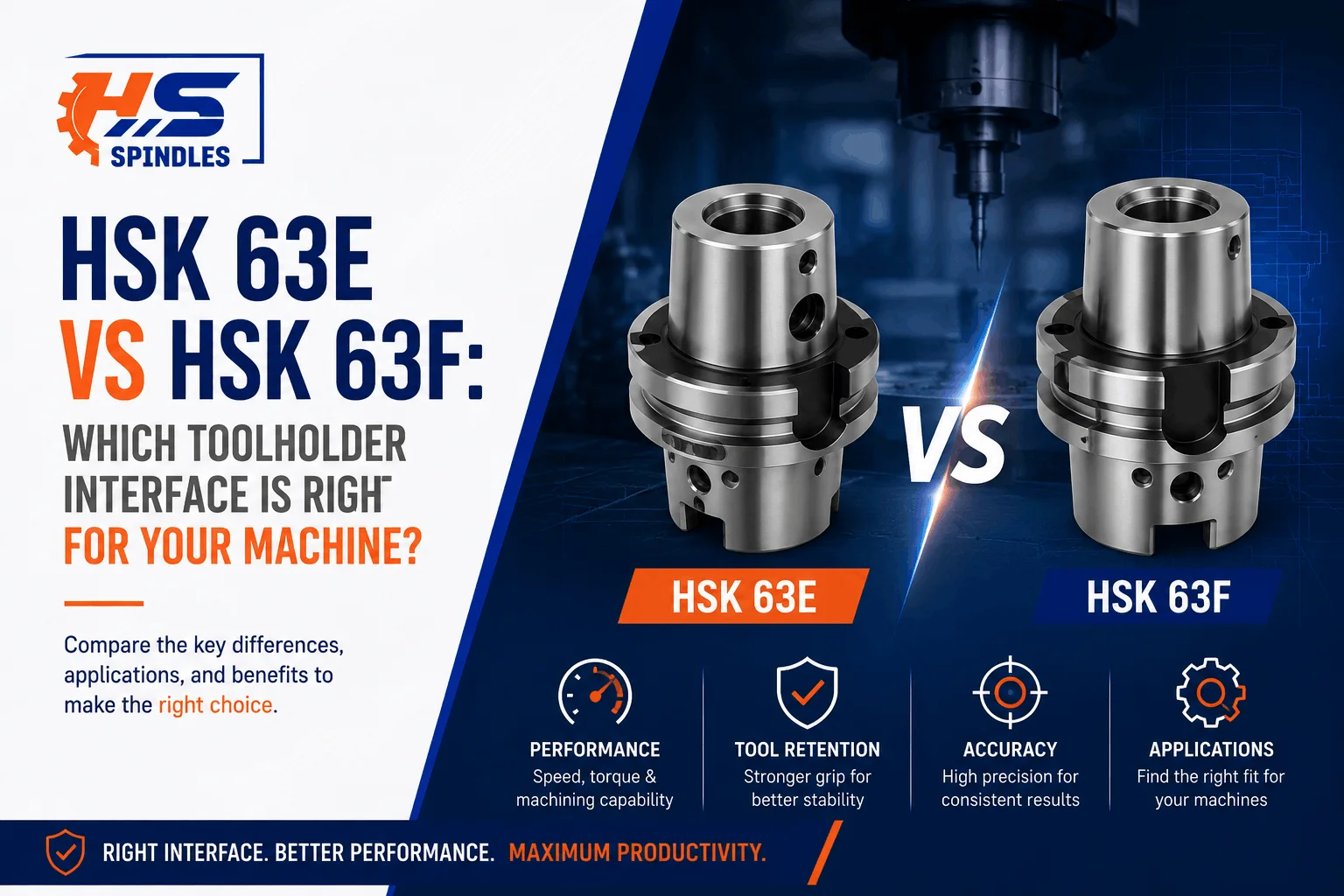
When investing in a new HSK spindle, selecting the right toolholder interface is just as important as choosing the spindle itself. Among the most common options available today are HSK 63E and HSK 63F.
At first glance, they appear nearly identical. Both use the HSK (Hollow Shank Taper) system, both are widely used on CNC routers, and both offer excellent accuracy and repeatability. However, they are designed for different machining requirements.
Choosing the wrong interface can affect machining performance, tool life, productivity, and even spindle longevity. Understanding the differences between HSK 63E and HSK 63F will help you make a more informed decision when purchasing equipment, replacing tooling, or planning a spindle upgrade.
What Is an HSK Spindle?
HSK stands for Hollow Shank Taper, a toolholding system developed to improve accuracy and performance at high spindle speeds.
Unlike traditional taper systems that rely primarily on taper contact, an HSK spindle uses both taper and face contact. This creates a more rigid connection between the spindle and toolholder, reducing vibration and improving machining accuracy.
Benefits of HSK spindle systems include:
- Improved tool stability
- Greater machining precision
- Better repeatability
- Faster tool changes
- Reduced vibration
- Superior high-speed performance
These advantages have made HSK spindles the preferred choice across woodworking, plastics, composites, aerospace, and manufacturing industries.
What Is HSK 63E?
HSK 63E is designed primarily for high-speed machining applications where lightweight tooling is important.
The “E” designation refers to a version of the HSK system optimised for speed and precision rather than maximum torque transmission.
HSK 63E is commonly found in:
- CNC routers
- Sign-making machinery
- Composite processing equipment
- Plastic machining centres
- High-speed woodworking applications
Because the toolholders are lighter, they place less stress on spindle bearings and allow machines to operate efficiently at higher rotational speeds.
Advantages of HSK 63E
- Lightweight design
- Excellent balance at high RPM
- Reduced spindle loading
- Improved acceleration and deceleration
- Ideal for precision machining
For businesses producing detailed components or operating at consistently high spindle speeds, HSK 63E can be an excellent solution.
What Is HSK 63F?
HSK 63F is one of the most widely used interfaces in industrial CNC routing applications.
While it maintains many of the high-speed benefits of the HSK system, it has been designed with greater torque transmission capability and stronger drive features.
HSK 63F is often used in:
- Cabinet manufacturing
- Furniture production
- Industrial woodworking
- Composite panel machining
- High-volume CNC routing
The design allows the spindle to transfer more cutting force to the tool, making it suitable for heavier machining operations.
Check out our HSK 63F Spindle collection →
Advantages of HSK 63F
- Higher torque capacity
- Stronger tool retention
- Better performance with larger tools
- Excellent durability
- Suitable for demanding production environments
For many CNC operators, HSK 63F provides the best balance between speed and cutting performance.
HSK 63E vs HSK 63F: The Key Differences
Torque Transmission
This is often the deciding factor.
HSK 63F is specifically designed to transmit more torque between the spindle and toolholder. This makes it better suited for heavier cuts and larger tooling.
If your machine frequently performs demanding routing operations, HSK 63F is generally the stronger option.
HSK 63E, while highly capable, is typically used for lighter cutting applications.
Toolholder Weight
HSK 63E toolholders are lighter than HSK 63F.
The lower mass helps:
- Reduce vibration
- Improve spindle responsiveness
- Minimise bearing loads
- Support higher operating speeds
For applications where speed is prioritised over cutting force, this can be a significant advantage.
Cutting Applications
HSK 63E is ideal for:
- Plastics
- Composites
- Precision routing
- Finishing operations
- High-speed machining
HSK 63F is better suited for:
- Production woodworking
- Heavy routing
- Larger tooling
- High material removal rates
- Continuous industrial operation
Tool Retention
HSK 63F generally offers stronger tool retention under load.
This becomes especially important when using larger diameter cutters or machining dense materials.
Manufacturers running demanding production schedules often prefer the added security provided by HSK 63F.
Which Industries Use HSK 63E?
HSK 63E is particularly popular in industries where speed and precision are critical.
Examples include:
- Sign manufacturing
- Aerospace composites
- Plastic fabrication
- Precision woodworking
- Advanced material processing
These industries often prioritise spindle speed and accuracy over aggressive material removal.
Which Industries Use HSK 63F?
HSK 63F is commonly found in production-focused environments.
Typical industries include:
- Furniture manufacturing
- Kitchen production
- Shopfitting
- Architectural joinery
- Industrial woodworking
Its ability to handle demanding workloads makes it one of the most common interfaces found on CNC routers throughout the UK manufacturing sector.
How Toolholder Selection Impacts Spindle Life
Choosing the correct toolholder interface does more than improve machining performance.
A properly matched toolholder helps reduce:
- Bearing wear
- Excessive vibration
- Heat generation
- Runout issues
- Premature spindle failure
Many spindle failures begin with vibration and imbalance issues that develop over time.
Regular maintenance and professional spindle inspections can help identify these problems before they lead to costly downtime. If you notice unusual noise, increased vibration, or declining cutting quality, it may be worth scheduling a spindle assessment.
Can You Swap Between HSK 63E and HSK 63F?
In most cases, no.
Although both interfaces share the same taper size, they are designed differently and require compatible spindle configurations.
Before purchasing tooling or replacing an HSK spindle, always verify:
- Machine specifications
- Spindle model
- Toolholder requirements
- Automatic tool changer compatibility
Using the incorrect interface can lead to poor performance and potential damage.
Which HSK Spindle Interface Should You Choose?
The answer depends entirely on your application.
Choose HSK 63E if your priority is:
- High spindle speeds
- Precision machining
- Lightweight tooling
- Composite or plastic machining
Choose HSK 63F if your priority is:
- Greater torque
- Larger cutting tools
- Production routing
- Heavy-duty machining
- Long-term durability
For many woodworking and manufacturing businesses, HSK 63F remains the most versatile choice. However, companies focused on high-speed precision work may benefit more from HSK 63E.
Final Thoughts
Both HSK 63E and HSK 63F offer the accuracy, repeatability, and reliability that make HSK spindle systems the preferred choice for modern CNC machinery.
The key difference lies in their intended application. HSK 63E is designed for lightweight, high-speed performance, while HSK 63F is built to handle greater cutting forces and demanding production workloads.
By understanding the strengths of each system, manufacturers can choose the toolholder interface that delivers the best combination of performance, reliability, and long-term value for their operation.

