
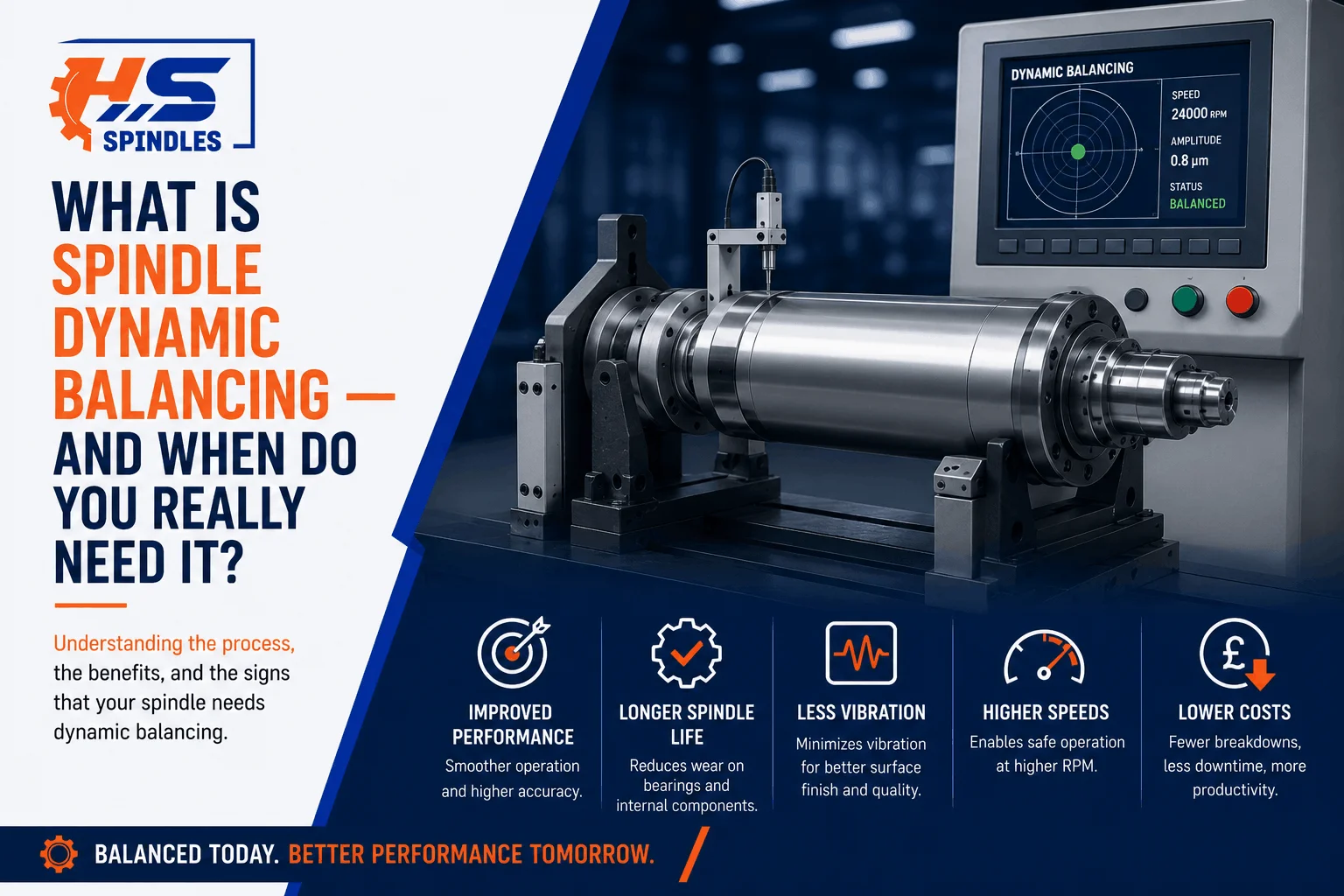
Ask ten CNC shop managers what spindle dynamic balancing is and you’ll get ten different answers. Some will tell you it’s something that happens during spindle repair. Some will tell you it’s about reducing vibration. Some will tell you it’s important for high-speed work. A few will tell you honestly that they’re not entirely sure what it involves — they just know their repair shop says they do it.
All of those answers contain something true. None of them is complete.
Spindle dynamic balancing is one of the most technically consequential steps in the entire spindle repair process. It is also one of the most frequently skipped, most often misrepresented, and least well understood by the people whose machining operations depend on it.
This article fixes that. By the end, you’ll know exactly what spindle dynamic balancing is, why it matters at high speed in a way it doesn’t at low speed, what happens to your machine and your parts when it’s done badly or not at all, and the specific questions to ask any repair shop to verify that they’re actually doing it properly.
Start With the Physics — Because the Physics Explain Everything
To understand why dynamic balancing matters, you need to understand one equation.
The centrifugal force generated by a rotating mass is:
F = m × r × ω²
Where m is the mass, r is the distance of that mass from the centreline, and ω is the rotational speed in radians per second.
Notice the ω². The centrifugal force doesn’t scale linearly with speed — it scales with the square of speed. Double the RPM and the force generated by the same imbalance quadruples. Triple the RPM and it increases ninefold.
This is the fundamental reason why dynamic balancing matters for high-speed spindles in a way it doesn’t for slow-rotating equipment. A small mass asymmetry in a spindle rotating at 3,000 RPM generates a small force — perhaps barely detectable. The same asymmetry at 18,000 RPM generates a force thirty-six times larger. At 24,000 RPM, it’s sixty-four times larger.
That force doesn’t disappear. It has to go somewhere. It goes into the bearings, into the spindle housing, into the machine structure, and — ultimately — into the surface of the part you’re cutting. Understanding this makes everything else in this article intuitive.
What Imbalance Actually Is
Imbalance in a rotating assembly exists when the mass is not distributed symmetrically around the axis of rotation. The centre of mass is not on the centreline. When the assembly rotates, this offset mass generates a centrifugal force that rotates with it — a force that reverses direction with every half revolution, loading the bearings cyclically and generating vibration.
In a perfect world, a spindle shaft, rotor, and collet chuck would be machined to such precise symmetry that no imbalance existed. In the real world, no machined component is perfectly symmetrical. Every component has microscopic variations in material density, dimensional geometry, and surface finish that create a small, inherent imbalance. Individually, these variations are tiny. Combined in an assembly, they can add up to something significant — particularly when the assembly runs at the speeds that CNC spindles operate.
There are three types of imbalance that matter for spindle systems:
Static imbalance exists when the centre of mass is offset from the rotation axis but is in the same axial plane — the heavy side is consistently on one side of the assembly regardless of its axial position. A statically unbalanced assembly will roll to the heavy side if placed on level rails. This is the simplest form of imbalance.
Couple imbalance exists when two equal and opposite imbalances exist at different axial positions along the shaft. The mass distribution is symmetric when viewed from the end — so the assembly would appear balanced statically — but during rotation, the two offset masses at different axial positions generate a rocking couple force that creates vibration in a characteristic nodding or wobbling pattern. Couple imbalance cannot be detected or corrected by static balancing. It requires dynamic measurement — hence dynamic balancing.
Dynamic imbalance is the combination of both — static and couple imbalance present simultaneously. This is the real-world condition of virtually every rotating assembly and is what dynamic balancing equipment measures and corrects.
Static Balancing vs. Dynamic Balancing — A Critical Distinction
This is where a lot of spindle repair claims fall apart on inspection.
Static balancing involves measuring and correcting imbalance in a single plane — typically by placing the rotating assembly on horizontal rails or a static balancing stand and allowing it to roll to the heavy side, then adding or removing mass to bring the centre of mass onto the rotation axis. It corrects static imbalance only.
For short, disc-like rotating components — a grinding wheel, a simple fan impeller — static balancing may be adequate. For spindle shaft assemblies, which have meaningful length along their rotation axis, static balancing is fundamentally insufficient.
Here’s why: a spindle shaft that has been statically balanced may still carry significant couple imbalance — offset masses at different axial positions that create the rocking forces described above. Static balancing cannot measure this couple component. It cannot correct it. A spindle that has been only statically balanced will still vibrate at operating speed due to the unresolved couple imbalance.
Dynamic balancing measures imbalance in two or more planes simultaneously while the assembly rotates. Purpose-built dynamic balancing machines measure the forces generated during rotation and calculate both the magnitude and angular position of the imbalance in each correction plane. Corrections — typically by adding balancing weights or removing small amounts of material — are made in both planes, addressing both static and couple imbalance.
For spindle assemblies, dynamic balancing is not a more thorough version of static balancing. It is the only method that actually works.
Any spindle repair shop that tells you they “balance” spindles without specifying that they perform two-plane dynamic balancing — on purpose-built balancing equipment, at operating speed — is either performing static balancing and calling it something else, or single-plane balancing that leaves the couple component unresolved. Either way, the spindle leaves their facility with unresolved imbalance that will affect your machine.
Explore our spindle services –
The Balance Standard That Actually Matters
Dynamic balancing quality is expressed in terms that are worth understanding, because they allow you to evaluate claims made by repair shops against an objective standard.
The internationally recognised standard for rotating machinery balance quality is ISO 21940 (formerly ISO 1940-1). This standard defines balance quality grades — designated G followed by a number — that specify the permissible residual specific unbalance for different types of rotating machinery.
The grade number represents the maximum permissible product of the residual specific unbalance and the operating speed, expressed in mm/s. A lower G number means tighter balance — less residual imbalance permitted.
For high-speed precision spindles — the type used in CNC machining, routing, and grinding — the relevant balance grades are:
G6.3 — The minimum acceptable grade for many general industrial applications. For high-speed spindles, G6.3 is inadequate. A spindle balanced only to G6.3 running at 18,000 RPM will generate detectable vibration.
G2.5 — Acceptable for some industrial spindle applications at moderate speed. Still not tight enough for precision, high-speed work.
G1.0 — The standard for precision spindles in demanding applications. At this grade, residual vibration is low enough to avoid measurable surface finish impact in most machining applications.
G0.4 — The tightest standard grade, used for precision grinding spindles and the most demanding high-speed machining applications.
At HS Spindles, we balance to 0.3 G’s or better — a practical expression that aligns with G1.0 to G0.4 depending on the operating speed of the specific spindle. This is not an aspirational target. It is the documented result we verify for every spindle before it leaves our facility.
When evaluating a repair shop’s balancing claims, ask specifically what balance grade they achieve, and ask for the measurement documentation. A shop doing proper dynamic balancing can give you a number. A shop doing inadequate balancing or no balancing will give you an assurance.
What Happens When Dynamic Balancing Is Skipped or Done Badly
The consequences of inadequate dynamic balancing are not immediate and dramatic — they are gradual and cumulative, which is precisely what makes them so insidious. The spindle comes back from repair and appears to work. Production resumes. And then, over weeks and months, things start going wrong.
Accelerated Bearing Wear
The centrifugal force generated by residual imbalance is applied to the spindle bearings with every revolution. At 18,000 RPM, the bearings experience this cyclic loading 300 times per second. It is not the individual loading event that destroys the bearing — it is the accumulated fatigue from hundreds of millions of loading cycles.
A spindle with poor dynamic balance may appear to run acceptably for three to six months after repair and then develop bearing noise and runout as the accumulated fatigue takes its toll. When the bearing fails and the spindle returns for a second repair, the cause — inadequate balancing on the first repair — is rarely identified. The bearing gets replaced again. The cycle repeats.
Surface Finish Degradation
The vibration generated by an unbalanced spindle is transmitted through the tool to the workpiece surface. At the frequencies generated by high-speed rotation, this vibration creates characteristic surface finish patterns — fine chatter marks, waviness, or periodic errors in surface texture that are detectable under inspection and measurable with a profilometer.
In high-value components — aerospace parts, precision moulds, optical surfaces — this surface quality degradation is a rejection cause. In general production work, it’s a quality drift that’s hard to attribute to a specific cause and gets addressed by slowing down, reducing depth of cut, or accepting higher scrap rates. None of these is the right solution. The right solution is a properly balanced spindle.
Reduced Tool Life
An unbalanced spindle causes the tool to cut with a wobbling, oscillating motion rather than a true circular path. This means the cutting edges are not all engaged equally — one edge takes more load than the others, wears faster, and causes the tool to fail prematurely. The uneven loading also generates heat at the cutting edge that accelerates wear beyond what correct cutting parameters would produce.
If your tool life has decreased noticeably since a spindle repair — with no change in cutting parameters, tooling specification, or workpiece material — poor dynamic balancing of the rebuilt spindle is one of the first things to investigate.
Spindle Housing and Machine Structure Effects
The vibration generated by an unbalanced spindle doesn’t stop at the spindle bearings. It transmits into the spindle housing, into the machine spindle head, and into the machine structure. Over time, this contributes to loosening of mechanical joints, wear in linear guides and ballscrew systems, and a general degradation of the machine’s geometric accuracy that is difficult to attribute to any single cause.
In a well-maintained machine, these structural effects are slow and manageable. In a machine running an unbalanced spindle at high speed, the process is accelerated significantly.
When Do You Really Need Dynamic Balancing?
The honest answer is: for any CNC spindle that runs above approximately 8,000 to 10,000 RPM, dynamic balancing is not optional. Below that speed range, the centrifugal forces generated by typical residual imbalance are small enough that their effect on bearing life and surface quality is minimal. Above it, the physics take over and the consequences of imbalance become real and measurable.
Here’s a practical breakdown:
Always Required
High-speed electrospindles (12,000 RPM and above). HSD, Hiteco, and similar electrospindles running at 12,000 to 24,000 RPM or beyond must be dynamically balanced to precision grade after every rebuild. At these speeds, even small residual imbalance generates significant bearing load and surface finish impact.
CNC routing spindles. CNC routing operates at high speed by definition. A spindle balanced inadequately on a routing machine running at 18,000 RPM will show surface finish problems and accelerated bearing wear quickly.
Grinding spindles. Surface and cylindrical grinding spindles are perhaps the most demanding application for dynamic balancing — the surface finish requirements in grinding are extremely tight, and imbalance-induced vibration is one of the primary sources of chatter and surface error in grinding operations.
Spindles after any repair or rebuild. Any time a spindle is disassembled and reassembled — even if all original components are retained — the assembly must be rebalanced. Reassembly changes the rotational relationship between components and therefore changes the imbalance state of the assembly.
Strongly Recommended
Machining centre spindles (8,000–12,000 RPM). At the lower end of this range, the consequences of imbalance are less immediate but still real over time. For spindles that will run regularly near the top of this range, dynamic balancing is worthwhile.
Any spindle where surface finish quality is critical. Regardless of speed, if the parts being produced have tight surface finish requirements, spindle balance should be verified. Imbalance-induced surface quality problems are subtle and easy to misattribute.
Spindles with a history of premature bearing failure. If a spindle has failed bearings more than once within a normal service interval, poor dynamic balancing from a previous repair is one of the most likely explanations.
Less Critical But Still Relevant
Low-speed drilling and tapping spindles (under 6,000 RPM). At these speeds, the centrifugal forces from typical imbalance are small. Dynamic balancing is still good practice but is unlikely to have a measurable impact on performance in normal applications.
The Right Way to Do It: What Proper Dynamic Balancing Looks Like
For spindle assemblies, proper dynamic balancing follows a specific process. Understanding it allows you to evaluate what a repair shop is actually doing.
Balancing at or near operating speed. Dynamic balancing must be performed with the spindle assembly rotating at a speed representative of its operating condition. Low-speed balancing — running the assembly at a few hundred RPM on a general-purpose balancing machine — does not adequately characterise the imbalance state at operating speed, because centrifugal effects that emerge at high speed are not present at low speed.
Two-plane correction. As discussed, spindle shaft assemblies require correction in two axial planes to address both static and couple imbalance. Single-plane balancing is inadequate.
Balancing the complete assembly. The balance state of the complete assembled spindle — shaft, rotor, bearings, collet chuck — is what matters. Balancing individual components separately and then assembling them introduces additional imbalance from the assembly process itself. The final balance measurement and correction must be performed on the complete, assembled spindle.
Documentation of the result. The residual imbalance after correction should be measured, recorded, and provided with the spindle as part of the repair documentation. This gives the customer evidence of the balance standard achieved and a baseline for future comparison.
Repeat measurement after correction. After balancing corrections are made, the assembly should be run again and the residual imbalance re-measured to confirm the target has been achieved. A single correction pass is not always sufficient for tight balance grades.
Questions to Ask Your Spindle Repair Shop About Balancing
If a repair shop tells you they balance spindles, these questions will tell you whether they’re actually doing it properly:
Do you perform two-plane dynamic balancing, or single-plane? The correct answer is two-plane dynamic. If they hesitate or can’t explain the difference, the balancing is inadequate.
At what speed do you balance the spindle assembly? The answer should be at or close to the spindle’s operating speed — or a speed that adequately characterises the operating condition. Low-speed balancing of high-speed spindles is not adequate.
What balance grade do you achieve, and how do you measure it? A specific number — G1.0, G0.4, 0.3 G’s — not a general assurance. If they can’t give you a grade, they’re not measuring to a standard.
Do you balance the complete assembled spindle, or individual components? The complete assembly. Component-level balancing doesn’t account for assembly-induced imbalance.
Will I receive a balancing report with the spindle? Yes should be the answer. The report should show the residual imbalance before and after correction, the speed at which balancing was performed, and the correction planes used.
If a shop can’t answer these questions specifically and confidently, their balancing capability is not what it needs to be for precision spindle work.
Spindle Dynamic Balancing at HS Spindles
At HS Spindles, dynamic balancing is not a checkbox on a repair form. It is a documented, verified, precision process that is performed on every spindle we rebuild — without exception.
We perform two-plane dynamic balancing in-house, at operating speed, using purpose-built balancing equipment. We balance to 0.3 G’s or better — consistently and verifiably, not as an aspiration. Every spindle leaves our facility with a balancing report that documents the residual imbalance before correction, the corrections made, and the final residual imbalance achieved.
We work across HSK, ISO, BT, CAT, and Hiteco spindle platforms for customers in aerospace, automotive, woodworking, composites, and oil and gas. If your spindle has been repaired and isn’t performing the way it should — surface finish issues, premature bearing wear, vibration at speed — inadequate dynamic balancing from the previous repair is one of the most likely causes. We’ll tell you honestly what’s wrong and fix it properly.
📞 +1 714-307-2332 ✉ engineering@hsspindles.com 🌐 hsspindles.com

