If you’ve spent any time around CNC machining, you’ve encountered ER collets. They’re on routers, machining centres, drilling machines, lathes, and grinding equipment across every industry that cuts metal, wood, plastic, or composite material. They’re the most widely used tool-holding system in CNC machining — and for good reason.
But walk into a toolroom or browse a tooling catalogue and the range of sizes, the terminology, and the specification details can be genuinely confusing. What does the number in ER16 or ER32 actually mean? Why would you choose ER25 over ER20? What’s the clamping range, and why does it matter more than most people think?
This guide answers all of it. By the end, you’ll know exactly what each ER collet size is designed for, how to match collet size to your application, and what to look for when you’re buying or replacing ER collets for CNC work.
What Is an ER Collet?
Before getting into sizes, it’s worth being precise about what an ER collet actually is and why the system works so well.
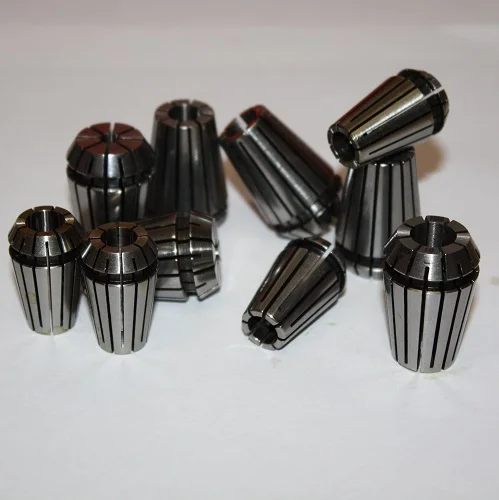
An ER collet is a slotted, tapered sleeve — typically made from hardened spring steel — that fits into a matching collet chuck or collet nut. When the collet nut is tightened, it compresses the collet radially against the tool shank, generating clamping force across the full circumference of the shank. The result is a secure, concentric grip that holds the tool accurately on the spindle centreline.
The ER system was developed by the Swiss company Rego-Fix in the 1970s. The name stands for “Rego-Fix” (ER) and the number refers to the nominal diameter of the collet in millimetres — so ER16 has a 16mm outside diameter at the collet body, ER32 has a 32mm outside diameter, and so on.
What made the ER system so successful — and what makes it still dominant today — is the clamping range. Unlike older collet systems where each collet grips only one specific shank diameter, an ER collet grips a range of shank diameters. A single ER32 collet, for example, can grip tool shanks from 3mm up to 20mm — depending on the specific collet selected from within the ER32 range.
This flexibility, combined with good concentricity, wide availability, and reasonable cost, is why the ER system became the global standard for CNC tool holding.
The ER Collet Range: Key Dimensions at a Glance
Before diving into each size individually, here’s the essential reference for the five most common ER collet sizes used in CNC machining:
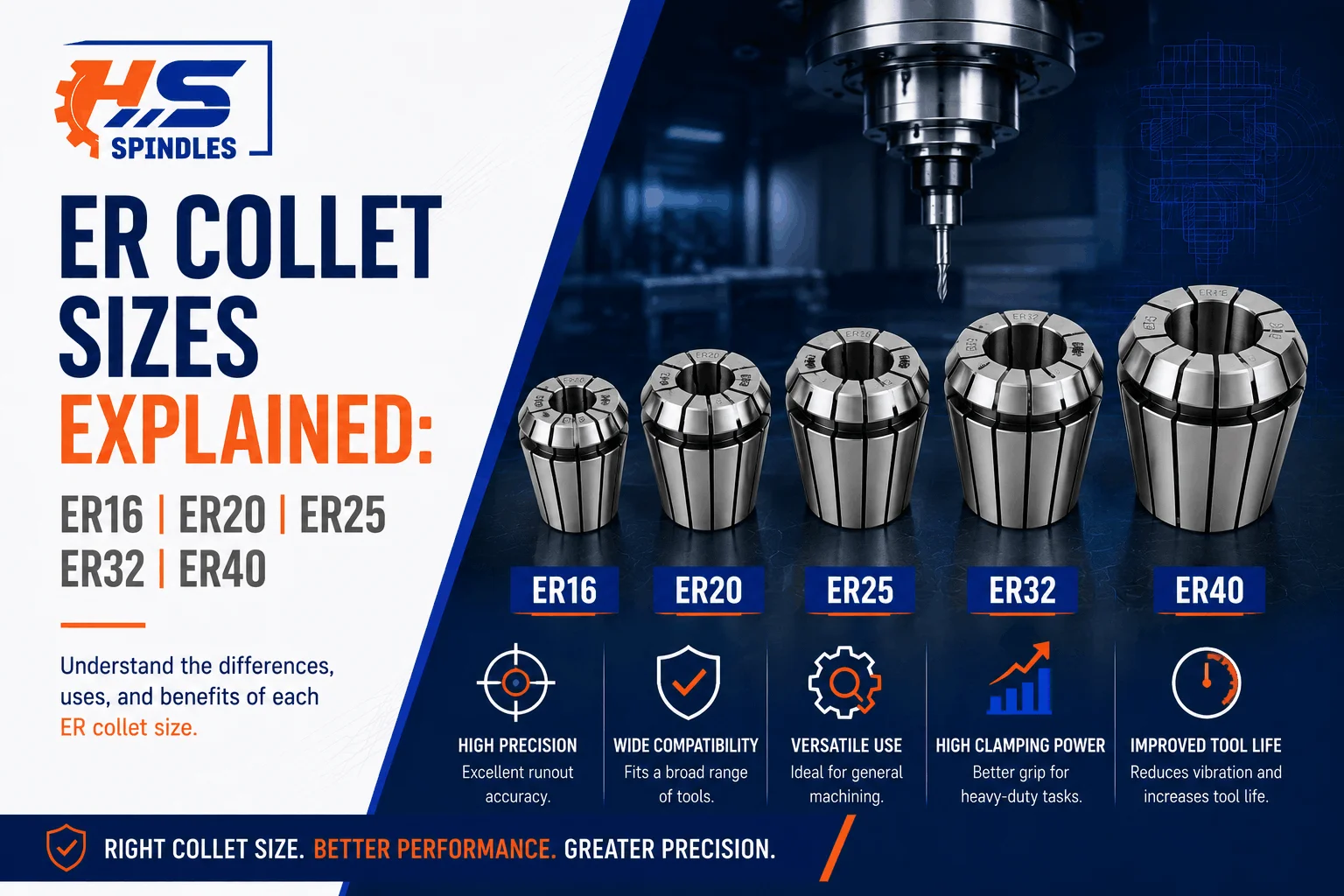
ER16 — Collet body diameter: 16mm. Clamping range: 1mm – 10mm. Typical applications: light routing, engraving, PCB drilling, small-diameter end mills.
ER20 — Collet body diameter: 20mm. Clamping range: 1mm – 13mm. Typical applications: CNC routing, light milling, drilling, aluminium machining.
ER25 — Collet body diameter: 25mm. Clamping range: 2mm – 16mm. Typical applications: general-purpose milling, mid-weight routing, steel drilling.
ER32 — Collet body diameter: 32mm. Clamping range: 3mm – 20mm. Typical applications: heavy milling, high-torque drilling, general machining centres.
ER40 — Collet body diameter: 40mm. Clamping range: 3mm – 26mm. Typical applications: large-diameter tooling, heavy-duty drilling, reaming, facing operations.
One important note: within each ER size, individual collets typically provide a clamping range of 1mm. So an ER32 collet marked “12” grips shanks from 11mm to 12mm. To cover the full ER32 range from 3mm to 20mm, you need a complete set of collets — one for each 1mm increment.
ER16 Collets — Small but Precise
ER16 is the smallest of the five common sizes and is designed for light-duty, small-diameter tooling applications where precision matters as much as — or more than — clamping force.
Clamping range: 1mm to 10mm Body diameter: 16mm Typical collet nut thread: M19 x 1.0
Where ER16 Is Used
ER16 collets are found most often in small CNC routing spindles and high-speed engraving machines. In printed circuit board (PCB) drilling applications, ER16 is one of the standard collet sizes because the drill shanks are small and the repeatability requirement — tools need to index to the same position reliably across thousands of tool changes — is extremely high.
In jewellery manufacturing and small-component precision machining, ER16 is used for tiny end mills, engraving cutters, and micro-drills where shank diameters may be as small as 1 or 2mm.
What to Know About ER16
Because ER16 operates at the smaller end of the ER range, it is particularly important that collet quality is high. At small shank diameters, the relationship between collet precision and tool runout is direct — a low-quality ER16 collet will introduce runout that significantly affects surface finish and tool life when you’re running a 3mm or 4mm end mill at high speed.
For ER16 applications, precision-grade collets with runout specifications of 5 microns or better are worth the investment. The tooling they hold is typically small and relatively expensive — high-quality micro-end mills are not cheap — and excessive runout caused by a poor collet costs more in broken tools and scrap parts than the saving on the collet.
Also: ER16 collets are not suitable for high-torque applications. The clamping force available from a 16mm body collet is limited, and attempting to drive large-diameter tooling through a small ER16 collet chuck will result in tool slip under load.
ER20 Collets — The Light-to-Medium Workhorse
ER20 is a step up from ER16 in both body size and clamping range, and it occupies a very common position in CNC routing and light milling applications.
Clamping range: 1mm to 13mm Body diameter: 20mm Typical collet nut thread: M25 x 1.5
Where ER20 Is Used
ER20 collets are widely used in CNC routing spindles — particularly the high-speed, compact spindles used in nested-based routing, sign-making, and light panel processing. A spindle rated for 18,000 to 24,000 RPM with an ER20 collet chuck is a very common configuration on entry-to-mid-range CNC routers.
In drilling applications, ER20 handles shank sizes up to 13mm — covering the majority of common drill sizes used in aluminium, wood, and light steel work. In milling, ER20 is adequate for end mills up to 12mm shank in aluminium and wood, though for steel milling at 12mm and above, an ER25 or ER32 is generally preferable for the additional clamping force.
What to Know About ER20
The jump from ER16 to ER20 provides meaningfully more clamping force — the larger body diameter allows a heavier collet nut and more total clamping area, which translates to better resistance to tool pull-out under cutting load.
ER20 is a good general-purpose size for routing operations where tool shanks are typically in the 6mm to 12mm range. It’s available in metric and imperial (inch) shank versions — important if you’re running tooling from North American suppliers, where 1/4″ and 1/2″ shanks are common.
One limitation: ER20 collets at the upper end of their range — 12mm and 13mm — are working near the clamping limit for the body size. For consistently reliable results with 12mm+ shanks in demanding applications, ER25 is the more appropriate choice.
ER25 Collets — The Versatile Mid-Range Option
ER25 sits in the middle of the common ER range and is one of the most genuinely versatile collet sizes available. It offers enough clamping force for serious milling work while remaining compact enough for spindles where space is a constraint.
Clamping range: 2mm to 16mm Body diameter: 25mm Typical collet nut thread: M31 x 1.5
Where ER25 Is Used
ER25 collets are used across a wide range of CNC machining applications — general-purpose vertical machining centres, CNC milling machines, drilling machines, and higher-end CNC routers. The 16mm maximum shank diameter covers the majority of end mills, drills, and reamers used in everyday machining work across steel, aluminium, and non-ferrous materials.
In production machining environments where operators run a mix of tool sizes — from 4mm or 6mm deburring tools up to 16mm face mills or drills — ER25 is often the collet size that covers the full range without requiring a collet chuck change. That versatility makes it a popular choice for machining centres where flexibility is valued.
What to Know About ER25
ER25 delivers a noticeable step up in clamping force over ER20, making it more suitable for milling in harder materials — mild steel, stainless steel, and hardened aluminium alloys — where tool pull-out forces are higher.
The 2mm minimum shank is worth noting: ER25 doesn’t go as small as ER16 or ER20 at the lower end of the range. If your application requires very small-diameter tooling alongside larger shanks, ER25 alone may not cover the full range — a separate ER16 or ER20 chuck for small-diameter work may be needed.
For high-speed applications above 18,000 RPM, it is important to verify that the ER25 collet and chuck combination being used is rated for the operating speed. At high RPM, unbalanced collet chucks generate vibration that affects both spindle life and surface finish.
ER32 Collets — The Production Machining Standard
ER32 is, by a significant margin, the most widely used ER collet size in industrial CNC machining. It is the default choice for general-purpose machining centres, and its 3mm to 20mm clamping range covers the vast majority of cutting tools used in everyday production machining.
Clamping range: 3mm to 20mm Body diameter: 32mm Typical collet nut thread: M40 x 1.5
Where ER32 Is Used
ER32 collets are the standard tool-holding solution on a huge proportion of the world’s machining centres — Haas, Mazak, DMG Mori, Doosan, Okuma, and virtually every other CNC machining centre manufacturer offers spindles and toolholders designed around ER32.
In production environments machining steel, cast iron, aluminium, titanium, and composites, ER32 handles the full range of common cutting tool sizes — from small-diameter drills and reamers up to 20mm end mills and boring bars. It is the right answer for the majority of general machining applications where a single collet size needs to do everything.
ER32 is also widely used in CNC lathes for live tooling applications — driven tool holders in turning centres typically use ER32 collets.
What to Know About ER32
The clamping force available from ER32 is significantly higher than ER25 or ER20 — the larger body diameter, heavier collet nut, and greater contact area combine to provide grip that is reliable across the full range of common cutting operations in steel and other demanding materials.
At the upper end of the range — 19mm and 20mm shanks — ER32 performs best when collet quality is high and tightening torque is correct. Under-torquing a large-shank ER32 collet in a heavy milling application is a common cause of tool slip that gets attributed to the collet rather than the installation.
Tightening torque for ER collets is a specification, not a guess. For ER32, the recommended tightening torque is typically in the range of 80–100 Nm depending on the shank size and collet manufacturer. Using a calibrated torque wrench, rather than tightening by feel, pays dividends in both tool security and collet longevity.
Collet quality matters enormously at ER32 because it is used in the most demanding applications. Precision-grade ER32 collets from reputable manufacturers — Rego-Fix, Schunk, Bilz, Haimer — deliver runout in the 3–5 micron range. Generic collets of unknown origin may deliver runout of 10–20 microns or worse, which is measurable in surface finish and accelerates tool wear.
ER40 Collets — Heavy-Duty Tool Holding
ER40 is the largest of the five common ER sizes and is designed for applications where large-diameter tooling, high cutting forces, or heavy-duty drilling and reaming demand the maximum clamping force the ER system provides.
Clamping range: 3mm to 26mm Body diameter: 40mm Typical collet nut thread: M50 x 1.5
Where ER40 Is Used
ER40 collets are used in heavy-duty machining applications where the shank diameters exceed what ER32 can reliably grip — typically 20mm to 26mm tool shanks on large end mills, shell mills, reamers, and boring tools.
In large machining centres working on heavy steel or cast iron components — structural aerospace parts, large moulds and dies, heavy industrial components — ER40 provides the clamping force needed to resist the torque generated by large-diameter cutting tools under aggressive cutting conditions.
ER40 is also used in some drilling applications where large-diameter drill shanks — 20mm and above — need to be held securely in a collet chuck rather than a dedicated drill chuck. The clamping force available from ER40 is sufficient for these applications in a way that smaller collet sizes simply are not.
What to Know About ER40
The mass of an ER40 collet chuck assembly is significant — more so than the smaller ER sizes. In applications where spindle speed is high, the balance of the ER40 chuck and collet combination becomes important. At 10,000 RPM and above, an unbalanced ER40 assembly generates vibration that is detectable in surface finish and accelerates spindle bearing wear.
For high-speed applications with ER40, specify balanced collet chucks — chucks that have been dynamically balanced as an assembly to G2.5 or better — and use balance-compatible collets. This is not a concern at the lower speeds typical of heavy-duty machining, but it matters in high-speed finishing operations.
The lower end of the ER40 clamping range — 3mm to 8mm shanks — is not where this collet performs best. Gripping a 4mm tool shank in an ER40 collet is possible but uses the collet well below its designed clamping capacity. For small-diameter tooling, use the appropriately sized collet. Use ER40 for what it’s designed for: large-diameter, high-force applications.
Choosing the Right ER Collet Size: A Practical Framework
With five sizes to choose from, the selection decision comes down to four variables.
Maximum shank diameter. Start here. The collet you choose must be capable of gripping the largest tool shank you need to run. If your largest tool is 18mm, ER32 covers it. If you regularly run 22mm or 25mm shanks, you need ER40.
Minimum shank diameter. The collet must also cover the smallest shank you need to grip. ER40 doesn’t go below 3mm. ER25 doesn’t go below 2mm. If you need to grip a 1mm or 1.5mm shank, you need ER16 or ER20.
Cutting forces and application. Higher cutting forces — heavier materials, larger depths of cut, higher feed rates — require larger collet sizes for the clamping force they provide. A 12mm end mill in aluminium is fine in ER25. A 12mm end mill in hardened steel at full depth is better served by ER32.
Spindle compatibility. Your collet must match the collet chuck fitted to your spindle. ER collet chucks are spindle-specific — a chuck sized for ER32 will not accept ER25 collets. If you’re matching collets to an existing spindle, identify the collet chuck size first.
ER Collet Quality: Why It Matters More Than Price
The ER collet system is one of the most widely copied tool-holding standards in the world. There are hundreds of manufacturers producing ER collets at every price point — from precision-grade collets by Rego-Fix, Schunk, and Bilz, down to anonymous budget collets sold at a fraction of the price.
The difference is not marketing. It’s measurable.
A precision-grade ER collet from a reputable manufacturer is ground to tight dimensional tolerances — typically delivering 3–5 microns of runout at the collet face. A budget collet of unknown origin may deliver 15–20 microns or worse. That difference directly affects:
Tool life. A tool running with 15 microns of runout cuts asymmetrically — one cutting edge takes more load than the others. This accelerates tool wear and increases the cost per part.
Surface finish. Runout translates directly to surface finish variation. For precision finishing operations, collet runout is a primary variable in surface quality.
Spindle bearing life. Runout creates cyclic loading on the spindle bearings. Over time, this accelerates bearing fatigue — particularly at high speed. Your spindle is a significantly more expensive component than your collet. Using cheap collets to save money on tooling costs is a false economy when the consequence is premature spindle bearing failure.
Consistency. Precision collets grip consistently and release cleanly, cycle after cycle. Budget collets may perform adequately initially and degrade faster — or perform variably from the start.
The recommendation is straightforward: buy the best ER collets you can source from a reputable manufacturer, use them correctly with the right tightening torque, and replace them at the first sign of wear or damage. The cost of a quality collet is trivial compared to the cost of the tooling it holds and the spindle it runs on.
ER Collets and Spindle Health
There is a direct relationship between ER collet condition and spindle health that is worth understanding explicitly.
A worn, damaged, or low-quality ER collet introduces runout — and that runout creates unbalanced cutting forces that load the spindle bearings asymmetrically. Over time, this accelerates bearing wear. In high-speed spindles running at 18,000 RPM or more, the effect is magnified because centrifugal forces scale with the square of speed.
Signs that collet condition may be contributing to spindle problems include:
- Surface finish degradation that isn’t explained by tool wear or cutting parameters
- Increased tool wear without changes in cutting conditions
- Vibration that appears at tool change frequency — where different tools in the same collet run differently
- Visible wear marks, fretting, or corrosion on the collet bore or external taper
Collets are wear items. They should be inspected regularly — cleaned, checked for damage, and replaced when worn. A collet replacement programme is a straightforward maintenance measure that protects both tooling investment and spindle health.
At HS Spindles, we supply precision ER collets across the full range — ER16, ER20, ER25, ER32, and ER40 — for CNC routing and machining applications. If you’re also dealing with a spindle that’s showing signs of wear or runout, our repair and rebuild service addresses the problem at its source — returning the spindle to the precision performance that quality tooling deserves.
📞 +1 714-307-2332 ✉ engineering@hsspindles.com 🌐 hsspindles.com
Checkout ER Collets offers
-
ER16 Collet Set, 5 Pieces, 3/8 Inch, P/N C-38-5P
Original price was: $130.00.$85.00Current price is: $85.00. -
ER20 Collet Combination Set 3 Pieces, Inch Sizes, High Precision, P/N C-D-3P
Original price was: $78.00.$54.00Current price is: $54.00. -
ER20 Collet Set 10 Pieces, 1/4 Inch, P/N C-D-14-10P
Original price was: $260.00.$180.00Current price is: $180.00. -
ER20 Collet Set 10 Pieces, Half Inch, High Precision, P/N C-D-12-10P
Original price was: $260.00.$180.00Current price is: $180.00. -
ER20 Collet Set 10Pieces 3/8 Inch, P/N C-D-38-10P
Original price was: $260.00.$180.00Current price is: $180.00. -
ER20 Collet Set 5 Pieces, Eigth Inch, High Precision, P/N C-D-18-5
Original price was: $130.00.$90.00Current price is: $90.00. -
ER20 Collet Set 5 Pieces, Half Inch, High Precision, P/N C-D-12-5P
Original price was: $130.00.$90.00Current price is: $90.00. -
ER20 Collet Set 5 Pieces, Quarter Inch, High Precision, P/N C-D-14-5P
Original price was: $130.00.$90.00Current price is: $90.00.