
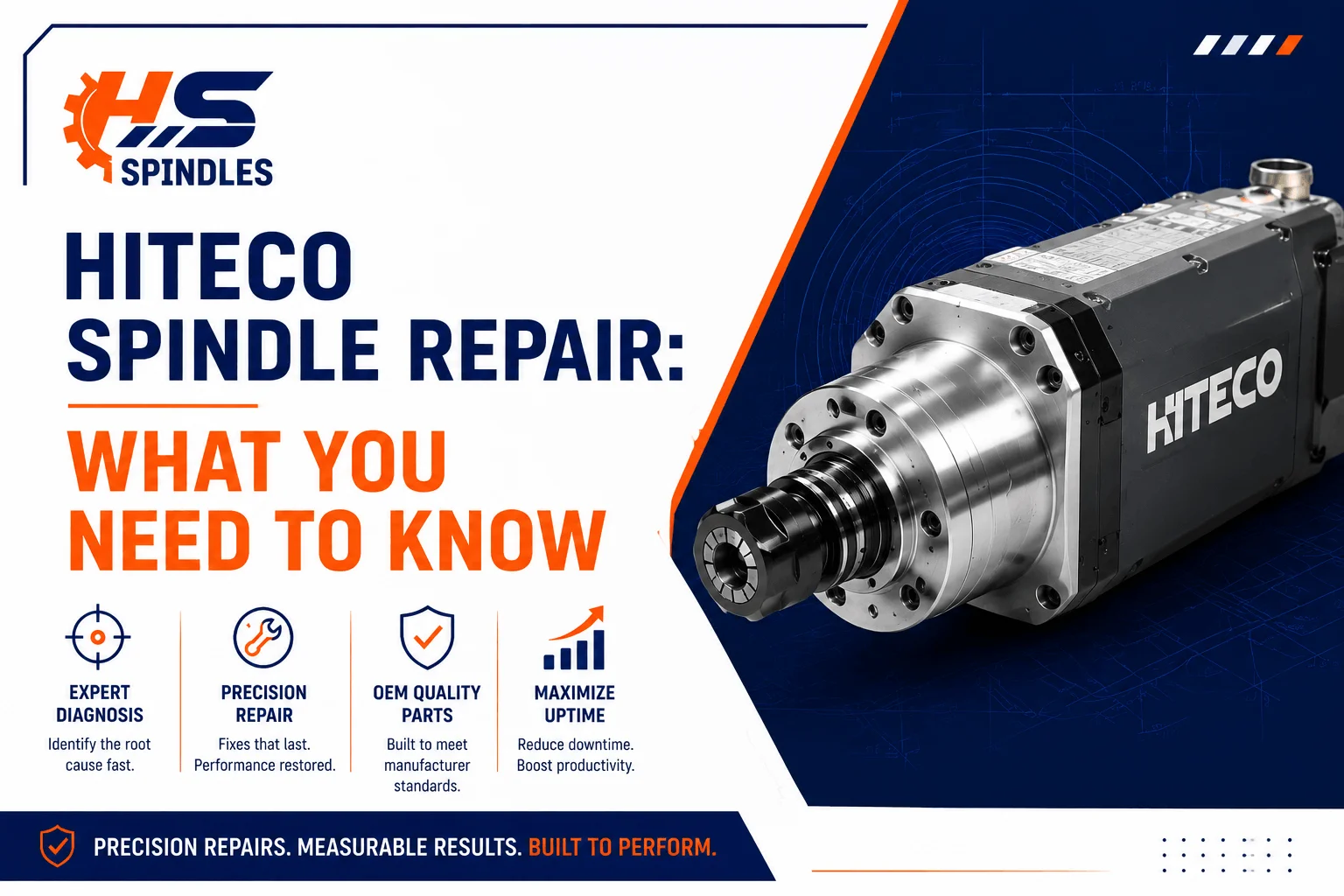
Hiteco spindles have a strong following for good reason. They’re well-engineered, platform-matched to the machines they run on, and built to deliver consistent performance across demanding production environments. Furniture manufacturers, panel processing shops, and aluminium machining operations across the world run Hiteco spindles day in and day out — and in well-maintained conditions, they run well for a long time.
But they are precision machines operating at high speed, under load, in environments that are often far from gentle. Contamination, accumulated run hours, tool crashes, cooling issues — all of the things that challenge any high-speed electrospindle will eventually challenge a Hiteco too.
When they do fail, the question that matters is whether the repair is done by someone who genuinely knows the platform. Hiteco spindles are not generic electrospindles. They have specific bearing arrangements, specific preload requirements, specific cooling configurations, and specific tool clamping mechanisms that vary across the model range. Repairing them properly requires platform-specific knowledge — not just general spindle experience.
This article covers what you need to know about Hiteco spindle repair: the failures that occur most often, what drives them, and what a repair done properly actually involves.
Understanding the Hiteco Range
Before getting into failures and repair, it’s worth understanding what Hiteco spindles actually are — because the range is broader than many people realise.
Hiteco is an Italian manufacturer producing electrospindles, tooling systems, and aggregate heads for CNC routing and machining applications. Their products are used heavily in the woodworking, furniture, composite, and aluminium processing industries, and are found on machines from a wide range of European and global CNC manufacturers.
The Hiteco range includes:
Fixed-speed and variable-speed electrospindles for CNC routing, operating at speeds typically between 12,000 and 24,000 RPM, with power ratings from a few kilowatts up to 15kW and beyond.
Air-cooled and liquid-cooled variants — air-cooled units are common in lighter-duty routing applications, while liquid-cooled spindles are used where continuous duty cycles or higher power demand requires active thermal management.
Manual tool change (MTC) and automatic tool change (ATC) configurations — ATC spindles use pneumatic drawbar systems to clamp and release ISO 30, HSK 63F, or other toolholder formats under CNC control.
Aggregate heads and angle heads — Hiteco also produces a range of aggregate tooling that mounts to spindles for multi-direction machining, drilling, and grooving operations.
Each of these configurations has its own failure profile and its own repair requirements. A liquid-cooled ATC unit running at 24,000 RPM with an HSK 63F interface is a fundamentally different repair job from an air-cooled MTC unit at 18,000 RPM, even if both carry the Hiteco name.
Common Hiteco Spindle Failures
1. Bearing Failure — The Most Frequent Problem
Bearing failure is the most common cause of Hiteco spindle repair across the entire model range. At the speeds Hiteco spindles operate, the bearing set is under significant and continuous stress — and it is the component most vulnerable to the environmental conditions that CNC routing creates.
The symptoms: The earliest sign is usually a change in running sound — the smooth, clean tone of a healthy spindle becomes rougher, grainier, or higher-pitched. As the failure develops, vibration increases. Surface quality on machined parts deteriorates. In more advanced failure, you may detect audible grinding, feel vibration through the machine structure, or see temperature readings rising on the spindle drive.
What causes it:
Seal and labyrinth failure. Hiteco spindles use labyrinth seal arrangements to exclude coolant and cutting debris from the bearing cavity, typically supplemented by an air purge system that keeps the cavity at positive pressure. When these systems degrade — worn labyrinths, failed seals, blocked or insufficient air purge — the protection fails. Coolant or fine dust enters the bearing cavity. Contamination in a bearing running at 20,000 RPM causes rapid, progressive damage.
This is the most common root cause of premature bearing failure in Hiteco spindles used in woodworking and panel processing environments, where fine dust is omnipresent and coolant misting is used extensively. The contamination pathway is almost always through a degraded seal or labyrinth — which is why seal condition is the first thing to assess in any Hiteco spindle bearing failure investigation.
Grease degradation. Hiteco spindles are grease-lubricated — the bearing sets are packed with high-speed grease during manufacture and are not regreased in service. At sustained high speed and elevated temperature, grease degrades. The base oil separates from the thickener, the lubricant film becomes inconsistent, and metal-to-metal contact in the bearing increases. This is a gradual wear-out process — normal at very high run hours — but it accelerates significantly if the spindle runs hot due to cooling issues or incorrect preload.
Preload errors from previous repairs. If a Hiteco spindle has been repaired before — particularly by a shop without specific experience on the platform — incorrect bearing preload is a common legacy issue. A preload that is too tight generates excess heat that accelerates grease breakdown and bearing fatigue. A preload that is too loose allows micro-movement of bearing elements under load, causing accelerated raceway wear and increasing runout over time.
Tool crash shock loading. A hard collision between the tool and the workpiece or machine fixture transmits shock loading through the tool, through the toolholder interface, and into the spindle shaft and bearings. Depending on the severity of the crash, this can cause immediate, detectable damage — brinelling of the raceways, visible indentations from ball impact — or it can cause microscopic damage that only manifests as premature failure weeks later. Any Hiteco spindle that has suffered a significant tool crash should be inspected, even if it appears to run normally immediately afterwards.
How we fix it:
Full disassembly in a clean, controlled environment. All bearing seats and shaft surfaces inspected and measured. The complete bearing set replaced with precision-grade angular contact bearings — P4 or P2 grade from manufacturers including GMN — matched to the specific Hiteco model’s speed rating and load requirements. Correct preload applied by calculation and controlled installation, verified by thermal monitoring during run-in. All seals and labyrinth components replaced as standard. Air purge system inspected and cleared. Dynamic balancing after assembly to 0.3 G’s or better. Full performance test before dispatch.
2. Overheating
Hiteco spindles are designed to run within defined thermal envelopes. When those envelopes are exceeded — whether through application overload, cooling system failure, or incorrect preload — the consequences are progressive and serious.
The symptoms: Spindle body running abnormally hot during operation. Drive thermal protection tripping, particularly during sustained cuts. Coolant outlet temperature higher than normal. Performance degradation during long runs that recovers after cooling. In severe cases, discolouration of the spindle body or a burnt smell.
What causes it:
Cooling system failure on liquid-cooled Hiteco spindles. The liquid-cooled variants in the Hiteco range rely on consistent coolant flow through internal passages within the spindle body. If coolant flow is restricted — a failing pump, a blocked passage, a kinked supply line, or a low coolant level — the spindle body temperature rises. This is the most common cause of overheating in liquid-cooled Hiteco units, and it’s preventable with regular cooling system maintenance.
Incorrect bearing preload — typically too tight. As discussed above, excessive preload generates heat at the bearing sets. That heat builds within the spindle body. As the spindle body heats, the interference fits between the bearing outer races and housing tighten, increasing preload further — a self-reinforcing cycle that, if unchecked, will destroy a bearing set in a matter of hours.
Running beyond rated duty cycle. Hiteco spindles, like all electrospindles, are rated for specific continuous and intermittent duty cycles. Running a spindle designed for 60% duty at 100% continuous generates sustained heat load that the cooling system cannot remove fast enough. This is an application problem, not a spindle fault — but the spindle bears the consequences.
Air-cooled spindles in inadequate ventilation. Air-cooled Hiteco units rely on airflow over the spindle body to dissipate heat. In machine enclosures with poor ventilation, or where the spindle is partially shrouded, airflow is insufficient and the spindle runs hot. This is particularly common when machines are retrofitted or when spindles are mounted in non-standard orientations.
How we fix it:
Full thermal assessment before repair begins. Coolant circuit inspected, flow measured, internal passages inspected for restriction and cleared. Bearing preload verified and reset correctly during rebuild. Thermal monitoring throughout run-in testing, with temperature stabilisation confirmed within OEM parameters before the spindle is cleared for dispatch.
3. Automatic Tool Change System Failures
ATC Hiteco spindles use pneumatic drawbar mechanisms to clamp and release toolholders — either ISO 30 or HSK format depending on the model. These systems are precise and reliable when correctly maintained, but they accumulate wear over thousands of tool change cycles and eventually require attention.
The symptoms: Tool pull-out during cutting — sudden loss of toolholder grip during a pass, which is both a quality problem and a safety hazard. Inconsistent tool seating causing runout variation between tool changes. ATC fault codes on the machine control. Unusual noise or hesitation during the tool change cycle.
What causes it:
Belleville spring fatigue. The Hiteco drawbar uses a Belleville washer spring stack to generate and maintain clamping force on the toolholder retention knob. Over tens of thousands of cycles, these springs fatigue — their spring rate decreases and the clamping force they generate drops below the threshold needed to hold tools securely under cutting load. Spring fatigue is a normal wear-out mechanism. It is also entirely preventable through timely replacement.
Gripper and collet wear. The gripper fingers or collet that engages the toolholder retention knob wear through repeated cycling. As the gripping surfaces wear, the engagement geometry changes. The gripper no longer seats correctly against the retention knob, effective clamping area reduces, and pull-out force decreases. Worn grippers are a common finding in Hiteco ATC spindles with high tool change counts.
Contamination in the tool taper bore. Chips, dust, and coolant residue accumulating in the HSK or ISO taper bore prevent toolholders from seating correctly against the spindle face. Even a thin layer of contamination at the taper interface reduces effective contact area and introduces runout. This is a maintenance issue — regular cleaning of the taper bore is essential — but in spindles coming in for repair after extended service, taper bore condition is always inspected.
Pneumatic system wear. The release mechanism is actuated by compressed air, and the pneumatic components — seals, O-rings, actuating pistons — wear over time. Worn pneumatic components cause unreliable release actuation, which can result in incomplete tool seating on the subsequent clamp cycle.
How we fix it:
Full drawbar disassembly. Belleville spring stack removed and tested against the Hiteco specification for the model — springs replaced as standard on any rebuild, regardless of apparent condition, because the fatigue is not always visible. Gripper and collet condition assessed, replaced where worn. Taper bore inspected and cleaned. All pneumatic seals and O-rings replaced throughout the release mechanism. Drawbar clamping force measured after reassembly using a calibrated pull-stud gauge and verified against specification.
4. Shaft and Housing Damage from Tool Crashes
Tool crashes are a reality in CNC machining — programming errors, fixture miscalculations, and operator errors happen in even the most well-run shops. A significant crash can cause immediate, obvious damage to a Hiteco spindle — bent shaft, damaged taper bore, shattered collet. It can also cause damage that’s not immediately obvious but will cause problems in service.
The symptoms of crash damage: Immediate runout that wasn’t present before the crash. Toolholder that doesn’t seat correctly or rocks in the taper. Vibration that appears immediately after the crash. In severe crashes, visible deformation of the spindle nose or housing.
What’s actually happening:
The spindle shaft in a Hiteco electrospindle is a precision-ground component manufactured to tight dimensional tolerances. A significant crash can bend the shaft — sometimes by a few microns, sometimes more measurably. Even a bend of 5–10 microns translates to a runout error of twice that at the tool tip, which is detectable in surface finish and measurable with a test indicator.
The HSK or ISO taper bore is equally vulnerable. A crash that drives the toolholder into the taper bore under shock loading can cause fretting or deformation of the taper surface — damage that prevents toolholders from seating correctly and causes runout regardless of toolholder quality.
The bearing sets absorb shock loading directly during a crash. As described above, the result can be immediate brinelling or microscopic fatigue that only manifests as noise and failure weeks later.
How we fix it:
Shaft runout measured after disassembly — typically with the shaft on V-blocks or between centres. Minor runout corrected through precision grinding or plating to restore the shaft to OEM tolerances. Where shaft damage is beyond reconditioning, shaft replacement. Taper bore inspected for damage — in some cases, the bore can be reground or lapped to restore correct geometry. In severe cases, housing replacement is the only option. Full bearing replacement as standard following any significant crash, regardless of apparent bearing condition.
5. Electrical and Drive Compatibility Issues
Hiteco electrospindles are driven by variable-frequency drives (VFDs) configured specifically for the spindle’s motor parameters. When the drive setup isn’t correct — or when the spindle is reinstalled after service without proper drive re-commissioning — problems that appear to be spindle faults are often electrical in origin.
The symptoms: Spindle failing to reach target speed. Drive faults — overcurrent, overtemperature, fault codes. Unusual noise at specific speeds. Torque that feels reduced at the tool. Motor running rough at certain frequency ranges.
What causes it:
Incorrect drive parameters after spindle replacement or repair. When a Hiteco spindle is reinstalled — whether after repair or replacement — the drive parameters must be set to match the specific spindle’s motor characteristics: rated voltage, rated current, rated frequency, number of poles, thermal protection settings. Using generic or approximate parameters causes the drive to run the motor incorrectly, generating either overcurrent, reduced torque, or thermal trips.
Drive faults misdiagnosed as spindle faults. A drive that’s developing a fault of its own — a failing output stage, degraded capacitors, a faulty encoder card — will cause symptoms that appear to originate in the spindle. Sending the spindle for repair when the problem is actually in the drive is a not uncommon and expensive mistake.
Encoder or feedback issues. Hiteco spindles with speed feedback encoders — used in rigid tapping or orientation-critical applications — can develop encoder faults that appear as speed instability or positioning errors. Encoder condition should be verified as part of any diagnostic investigation.
How we fix it:
Drive compatibility and parameter verification is part of our Hiteco spindle repair process. We measure motor winding resistance and insulation resistance as part of every inspection — this distinguishes a spindle motor fault from a drive fault. Where drive parameters are suspected as a contributing factor, we provide the correct motor data to allow accurate drive configuration. Encoder integrity checked on units with feedback systems.
The Repair Process for Hiteco Spindles
Whatever the failure mode, proper Hiteco spindle repair follows a consistent, rigorous process:
Incoming inspection and documentation. Every Hiteco spindle that arrives at our facility is assessed before disassembly — symptoms logged, initial measurements taken, fault reported by the operator reviewed. This creates the baseline for the repair investigation.
Full disassembly in a clean environment. Complete teardown in a contamination-controlled environment. Every component documented and individually assessed. No assumptions about what is or isn’t serviceable.
Component measurement against specification. Shaft runout, housing bore geometry, drawbar spring force, winding resistance, insulation resistance — all measured against Hiteco’s published specifications or established engineering tolerances for the model.
Precision component replacement. Bearings, seals, springs, grippers — replaced with components that meet or exceed Hiteco specification. Bearing grade appropriate to the speed rating of the specific model.
Correct preload assembly. Bearing preload set by specification and controlled installation. Not approximated. Not set by feel. This step determines whether the repair lasts or fails prematurely.
Dynamic balancing. Every Hiteco spindle balanced in-house after assembly, at operating speed, to 0.3 G’s or better. Two-plane balancing for shaft assemblies.
Run-in testing with thermal monitoring. Spindle run at operating speed with continuous temperature monitoring. Bearing temperature must stabilise within OEM limits before the spindle is cleared. A spindle that runs hot on the bench will run hot in the machine.
Performance testing and documentation. Runout measured at the tool interface. Vibration measured across the full speed range. Drawbar clamping force verified on ATC models. All results documented and provided with the spindle.
Choosing the Right Hiteco Spindle Repair Provider
Not every spindle repair shop has the specific experience that Hiteco spindle repair requires. When evaluating a provider, the questions that matter most are:
Do they have documented experience with Hiteco spindles specifically? General electrospindle experience is a starting point, not a qualification. Ask whether they’ve worked on your specific Hiteco model. Ask what common failures they see on that platform. The answers will tell you quickly whether the experience is real.
Do they use precision-grade bearings from named manufacturers? P4 or P2 grade angular contact bearings from manufacturers like GMN are the standard for precision spindle work. Generic or unspecified bearings are not.
Do they perform in-house dynamic balancing? At Hiteco’s operating speeds, dynamic balancing is not optional. It must be performed in-house, at operating speed, to a stated standard.
Do they provide documented test results? Runout measurements, vibration figures, thermal performance during run-in, drawbar force on ATC models — all of this should be documented and provided with the repaired spindle.
Do they offer a meaningful warranty? A shop confident in their work offers written warranty terms that are clear about coverage, duration, and claims process.
Hiteco Spindle Repair at HS Spindles
HS Spindles is an authorised Hiteco partner — and that matters. It means we have access to genuine Hiteco parts, technical documentation, and manufacturer support. It means our technicians have platform-specific training on Hiteco spindle architecture. And it means that when we repair a Hiteco spindle, we’re doing it with the same level of knowledge and access that the manufacturer would bring to the job.
Every Hiteco spindle repair we perform follows the full process described above. Precision-grade bearings. Correct preload by specification. In-house dynamic balancing to 0.3 G’s or better. Full performance testing with documented results. Written warranty terms.
We supply and service Hiteco spindles for customers across the US and internationally.
If your Hiteco spindle is showing problems — or if you want an honest assessment of a repair that hasn’t resolved the issue — contact us. We know the platform, and we’ll tell you straight what’s going on and what it takes to fix it properly.
📞 +1 714-307-2332 ✉ engineering@hsspindles.com 🌐 hsspindles.com

