
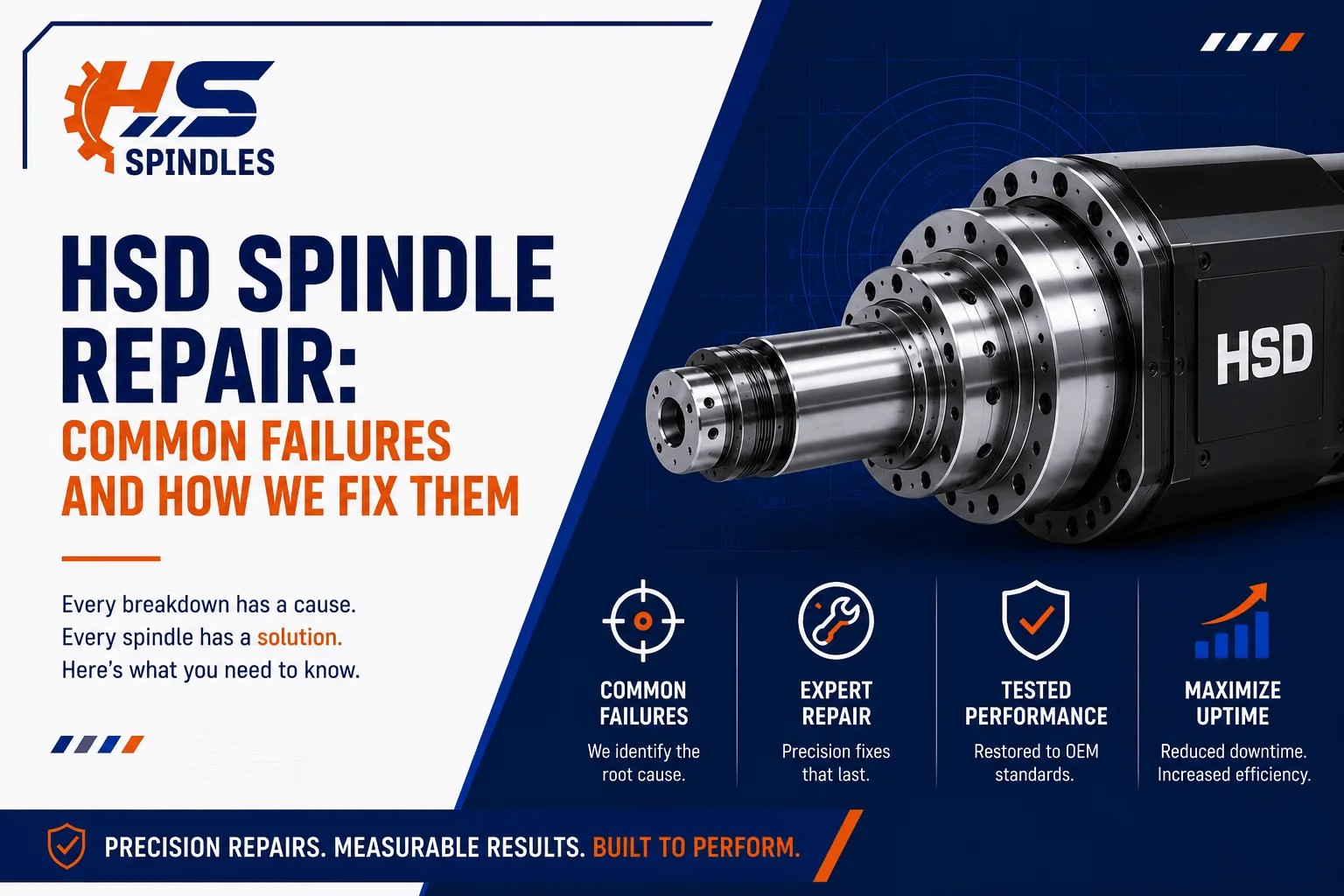
HSD spindles have earned their reputation the hard way — through years of running in some of the most demanding CNC routing, machining, and woodworking environments in the world. They’re well-engineered, well-supported, and built to a standard that gives them genuine longevity when they’re properly maintained.
But they do fail. Every spindle does, eventually. And when an HSD spindle starts showing problems — unusual noise, vibration, loss of precision, overheating — the question isn’t whether it can be repaired. In the overwhelming majority of cases, it can. The question is whether it gets repaired properly.
This article covers the failures we see most often on HSD spindles, what causes them, and exactly what a proper repair involves. If you’re currently dealing with a problem on an HSD unit, this will help you understand what you’re looking at — and what to expect from a repair that’s done right.
A Brief Word on HSD Spindles
HSD is an Italian manufacturer — part of the SCM Group — producing a wide range of electrospindles, aggregate heads, and tooling systems for CNC routing, machining centres, and woodworking equipment. Their spindles are found across a huge variety of applications: furniture manufacturing, composite panel routing, aluminium machining, stone processing, and aerospace component work.
The HSD range spans from compact, air-cooled units designed for light routing work all the way to heavy-duty, liquid-cooled electrospindles running at 24,000 RPM and beyond, with HSK 63F or ISO 30 interfaces and integrated automatic tool change systems.
What this means for repair is that HSD spindles are not a monolithic category. An HSD ES330 running at 18,000 RPM on a nesting router is a fundamentally different machine from an HSD ES929 on a five-axis machining centre. The failure modes overlap, but the specifics — the bearing specifications, the preload settings, the cooling requirements, the tool clamping mechanisms — vary between models. Proper HSD spindle repair requires familiarity with the specific platform, not just a general knowledge of electrospindle principles.
Common HSD Spindle Failures — and What Actually Causes Them
1. Bearing Failure
This is the most common failure on any high-speed electrospindle, and HSD spindles are no exception.
At 18,000 to 24,000 RPM, the angular contact bearings that support the spindle shaft are operating under significant stress. They are also operating in an environment where contamination, lubrication failure, or incorrect preload can cause rapid degradation.
The symptoms: The most common early symptom of bearing failure in an HSD spindle is elevated noise — a change in the spindle’s running tone, from a clean, smooth sound to a rougher, grainier one. As the failure progresses, vibration increases. Surface finish deteriorates. Eventually, the spindle may develop audible grinding or rumbling, and in advanced failure, the shaft may develop detectable runout or temperature spikes.
What causes it:
Contamination. HSD spindles use labyrinth seals and air purge systems to keep coolant and debris out of the bearing cavity. When these systems fail — worn seals, blocked air purge lines, or excessive coolant pressure — moisture and particulate enter the bearing cavity. Contamination is the single most common root cause of premature bearing failure in HSD spindles operating in wet or high-chip environments.
Lubrication degradation. HSD spindles are typically grease-lubricated for life — meaning the grease packed into the bearings during manufacture is expected to last the service life of the bearing set. In practice, at very high speeds and temperatures, grease degrades over time. The lubricant film thins, metal-to-metal contact increases, and bearing wear accelerates. This is a normal wear-out mechanism — but it happens faster when the spindle runs hot.
Incorrect preload. HSD spindles, like all precision electrospindles, require precisely controlled bearing preload. If a previous repair was done with incorrect preload — too tight or too loose — the bearings will wear prematurely. Too tight generates excess heat. Too loose allows bearing element movement and accelerates fatigue. Either way, the result is premature failure.
Tool crash damage. A significant tool crash transmits shock loading through the spindle shaft and directly into the bearing sets. This can cause brinelling — small indentations in the bearing raceways from ball impact — which creates noise and runout immediately, and accelerates bearing fatigue over time.
How we fix it: Full disassembly, cleaning, and inspection of all bearing seats and shaft surfaces. Replacement of the complete bearing set with P4 or P2 grade angular contact bearings from manufacturers including GMN — matched pairs installed with the correct preload for the specific HSD model. Seal and labyrinth inspection and replacement. Dynamic balancing after assembly. Full run-in with thermal monitoring to verify preload is correct.
2. Motor Winding Failure
HSD electrospindles have the motor integrated directly into the spindle body — the rotor is pressed onto the spindle shaft, and the stator windings are housed within the spindle body. This integration is what gives HSD spindles their high-speed capability and compact form factor. It also means that when the motor fails, the spindle assembly has to come apart.
The symptoms: Motor winding failure typically manifests as one of three things. The spindle may fail to reach target speed, or drop speed unexpectedly under load. It may trip electrical protection — the drive or inverter reports a fault, usually an overcurrent or insulation fault. Or it may generate abnormal heat from the spindle body itself, even at light load.
What causes it:
Insulation breakdown. The winding insulation in HSD electrospindles is designed for the thermal environment of the spindle — but sustained overtemperature degrades insulation over time. Running a liquid-cooled HSD spindle with inadequate coolant flow, or running at high load continuously without allowing thermal stabilisation, accelerates insulation ageing. Eventually, insulation failure causes winding shorts that make the motor unusable.
Coolant ingress. On liquid-cooled HSD models, a failure in the internal cooling circuit — a cracked coolant jacket, a failed O-ring at the coolant inlet, or a joint that has worked loose over time — can allow coolant to contact the stator windings. Water and high-voltage motor windings are obviously incompatible. Even minor coolant ingress causes insulation damage.
Voltage and drive faults. An incorrectly configured spindle drive — wrong frequency, wrong voltage, incorrect acceleration ramp — can subject the motor windings to stresses they were not designed for. This is more common when a spindle is reinstalled after machine maintenance, or when a drive is replaced without careful parameter re-entry.
Age and accumulated hours. HSD electrospindle motors are designed for long service, but they are not infinite. Very high run-hour units will eventually show insulation resistance values declining toward the failure threshold, even without any specific fault event.
How we fix it: Full disassembly. Stator winding resistance and insulation resistance measured against HSD specification. Where windings are repairable — partial insulation failure, localised damage — rewinding by qualified motor repair technicians. Where stator damage is too extensive, stator replacement. Coolant circuit integrity checked and repaired. Drive parameter verification before commissioning.
3. Tool Clamping System Failure
The majority of HSD spindles used in CNC routing and machining applications feature automatic tool change (ATC) systems — pneumatic drawbar mechanisms that clamp and release toolholders under CNC control. These systems are elegantly designed but are subject to wear over high cycle counts.
The symptoms: Tool pull-out during cutting — the most dangerous and obvious symptom. Tools that seat inconsistently, causing runout at the toolholder. ATC cycle faults — the machine control reports a tool change error because the drawbar isn’t confirming clamp or release correctly. Unusual noise during tool change cycles.
What causes it:
Drawbar spring fatigue. The HSD drawbar uses a Belleville spring stack to generate clamping force. Over tens of thousands of tool change cycles, these springs fatigue. The clamping force they generate decreases. Below a critical threshold, the toolholder is no longer held securely under cutting load, and tool pull-out becomes possible.
Collet and gripper wear. The collet fingers or gripper segments that engage the toolholder retention knob wear over time. Worn grippers don’t engage the retention knob correctly, reducing effective clamping force even when the drawbar spring stack is intact.
Contamination in the clamping bore. Chips, coolant residue, and general contamination in the tool clamping bore prevent toolholders from seating correctly. This creates runout at the interface and reduces the effective contact area for clamping.
Pneumatic system issues. The release mechanism on ATC HSD spindles is pneumatically actuated. Low air pressure, contaminated air supply, or worn pneumatic seals within the drawbar mechanism cause unreliable tool release — which can manifest as incomplete tool seating on the subsequent clamp cycle.
How we fix it: Full drawbar disassembly. Belleville spring stack measured and replaced if clamping force is below HSD specification. Collet or gripper replacement. Tool clamping bore cleaning and inspection. Pneumatic seals replaced throughout the release mechanism. Drawbar force measured after reassembly using a calibrated pull-stud gauge — we verify actual clamping force against HSD’s specification, not just function-test the cycle.
4. Excessive Vibration and Runout After Previous Repair
This failure mode is uncomfortable to talk about, but it’s real and it’s common: HSD spindles that have been repaired by an unqualified shop and returned to service with problems that weren’t present before, or weren’t properly addressed.
The symptoms: Vibration that’s worse than before the repair, or that appears at specific speeds. Surface finish that has improved from the failure state but is still noticeably worse than the spindle’s original performance. Tooling that wears faster than expected. Bearings that fail again within months of a repair.
What causes it:
Incorrect bearing installation. Bearings forced rather than properly pressed. Incorrect orientation of angular contact bearing pairs. Preload set by feel rather than measurement.
No dynamic balancing, or inadequate balancing. An HSD spindle running at 18,000 RPM that hasn’t been properly balanced will vibrate. The imbalance forces at those speeds are significant. A shop that doesn’t have in-house dynamic balancing capability — or that performs only static balancing — will return a spindle that runs, but doesn’t run well.
Shaft not inspected or reconditioned. A shop that replaces bearings without checking shaft runout may be reinstalling good bearings on a damaged shaft. The runout that results is then attributed to bearing quality or some other cause, and the real problem goes unresolved.
Wrong replacement components. Generic bearings fitted in place of precision-grade ones. Incorrect preload spacers. Seals that don’t match the original specification.
How we fix it: Full recommissioning inspection — treating the spindle as if the previous repair hadn’t happened. Full disassembly, shaft runout measurement, housing bore measurement, bearing seat inspection. New precision-grade bearing set with correct preload. Dynamic balancing in-house to 0.3 G’s or better. Full performance testing with documented results. We identify what the previous repair got wrong and correct it — not just replace what’s obviously failed.
5. Overheating
Heat is the enemy of every precision spindle, and HSD units are no exception. Overheating accelerates bearing grease degradation, degrades winding insulation, causes thermal expansion that affects preload, and in severe cases, causes permanent damage to the spindle housing and shaft.
The symptoms: Spindle body running hot to the touch during normal operation. Thermal cutout trips on the drive. Coolant outlet temperature higher than specification. Gradual performance degradation during long production runs that improves after the spindle cools down.
What causes it:
Coolant flow restriction. On liquid-cooled HSD models, the most common cause of overheating is a problem with the cooling circuit — low coolant flow rate, blocked passages within the spindle body, or a failing coolant pump. HSD specifies minimum coolant flow rates for each model; below those rates, the spindle will run hot.
Incorrect bearing preload. A bearing set installed with excessive preload generates heat internally. This heat builds within the spindle body and compounds — as the spindle gets hotter, the bearing preload increases further due to thermal expansion, generating more heat still. This is a self-reinforcing failure mode that, left unaddressed, will destroy a bearing set within hours of operation.
Blocked air purge. HSD spindles use a low-volume air purge to keep the bearing cavity pressurised and prevent contamination ingress. A blocked air purge line can also contribute to elevated bearing temperature by reducing the small amount of airflow through the bearing cavity.
Application mismatch. Running an HSD spindle at continuous high load — particularly in aggressive material removal applications that exceed the spindle’s duty cycle rating — generates heat that the cooling system cannot adequately remove. This is an application problem rather than a spindle fault, but the spindle pays the price.
How we fix it: Root cause identification before any repair work begins. Coolant circuit inspected, flow measured, passages cleared or repaired. Bearing preload verified and corrected during rebuild. Air purge system checked and cleared. Application parameters reviewed if overheating appears to be duty-cycle related. Thermal monitoring during run-in after repair to confirm the spindle stabilises at correct operating temperature.
What a Proper HSD Spindle Repair Looks Like
Across all of the failure modes above, proper HSD spindle repair follows the same fundamental process:
Incoming inspection and diagnosis. The spindle is assessed before a single bolt is turned — symptoms documented, initial measurements taken, reported fault investigated. This step determines the repair scope. It is not optional.
Full disassembly in a clean environment. HSD spindles are disassembled completely in a contamination-controlled environment. Every component is laid out, documented, and individually assessed. Nothing is assumed to be serviceable until it has been measured.
Component measurement against HSD specification. Shaft runout. Housing bore geometry. Drawbar spring force. Winding resistance and insulation values. Every critical parameter measured against HSD’s published specifications or established engineering tolerances for the specific model.
Precision component replacement. Bearings, seals, springs, grippers — replaced with components that meet or exceed HSD specification. Not generic equivalents. Not “comparable” parts. The right parts for the specific model.
Correct preload assembly. Bearing preload set by calculation and controlled installation, not by feel or approximation. This is the most technically demanding step in the rebuild and the one most likely to be compromised by an unqualified shop.
Dynamic balancing. Every rebuilt HSD spindle balanced in-house at operating speed, to 0.3 G’s or better. Two-plane balancing for shaft assemblies. No exceptions.
Performance testing and documentation. Run-in at operating speed with thermal monitoring. Runout measured at the tool interface. Vibration measured across the speed range. Drawbar clamping force verified. Results documented and provided with the spindle.
HSD Spindle Repair at HS Spindles
At HS Spindles, we have extensive hands-on experience with HSD electrospindles across the full model range — from compact air-cooled routing units to heavy-duty liquid-cooled machining electrospindles with HSK 63F and ISO 30 interfaces.
Every HSD spindle repair we undertake follows the process above. We use precision-grade bearings from manufacturers including GMN. We balance in-house to 0.3 G’s or better. We document everything and provide test results with every repair. And we give you an honest assessment of what went wrong and why — so you understand not just what we fixed, but what caused the failure in the first place.
If your HSD spindle is showing signs of trouble — or if you’ve had a repair elsewhere that hasn’t resolved the problem — contact us. We’ll tell you straight what we’re looking at and what it will take to fix it properly.
📞 +1 714-307-2332 ✉ engineering@hsspindles.com 🌐 hsspindles.com

